Pentara® logo

Publications

Over 200 publications, including the composite endpoints regulators now recognize. We publish our methodology in the open so reviewers meet it before your submission does.

200+
Publications
1996–2026
Span
28
Contributing authors
White paper

Global Statistical Tests: powering the trial your budget can actually fund

When the sample size a conventional design demands is larger than the trial you can run, a Global Statistical Test lets the clinical-endpoint hypotheses be tested anyway. The paper sets out when GST applies, how it is pre-specified, and how it has been received in review.

One email with the PDF. No sequence, no follow-up unless you ask for one. We use your details only to send it; see our Privacy Policy.

Research

Publications library

Showing the 50 most recent

Sorted newest first

  1. 2026 · Alzheimers Dement.

    Evaluating digital cognitive tests for clinical use in Alzheimer's disease: A novel framework and scoping review

    Hendrix, Suzanne

    Abstract

    Mild cognitive impairment (MCI), a prodromal stage of Alzheimer's disease (AD), remains undiagnosed in > 90% of individuals, delaying access to timely evaluation and interventions. Self-administered digital cognitive assessments (SA-DCAs) offer scalable approaches for early detection, yet their real-world validation and clinical readiness remain uncertain. We developed a use-case-specific framework to evaluate SA-DCAs intended for community and primary-care MCI screening and applied it to a comprehensive scoping review of published evidence (2012-2025). Among 79 identified SA-DCAs, only four tools met predefined framework criteria across nine eligible studies. Common limitations included restricted population representativeness, inconsistent diagnostic performance reporting, limited biomarker anchoring, and reliance on prefiltered cohorts. Overall, the current evidence base is methodologically heterogeneous and incomplete for clinical deployment. The proposed framework characterizes requirements including anchoring strength, prevalence-adjusted performance reporting, and representative sampling establishing a foundation for advancing robust real-world evidence needed to translate SA-DCAs from research to clinical practice.

    Open → (opens in a new tab)
  2. 2026 · Stat Med.

    Time-Scale Target Parameters and Two-Step Estimation in Longitudinal Trials for Progressive Diseases

    Mallinckrodt, Craig · Dickson, Samuel · Hendrix, Suzanne

    Abstract · matched in abstract

    In progressive diseases such as Alzheimer's, treatments that slow progression should start early to preserve higher levels of functioning for a longer period. In corresponding clinical trials, treatment effects are usually expressed as mean differences on a clinical scale at fixed time points. Early in the disease course, however, these mean differences may appear small but may nonetheless correspond to an important slowing of disease progression. This complicates the appreciation of the relevance of observed treatment effects. We introduce a class of target parameters that quantify treatment effects on the time scale in longitudinal studies; for instance, in terms of time saved or percentage slowing of progression. We focus on data from randomized trials where the target parameters are identified under regularity assumptions. These target parameters remain well defined if treatment was not randomized, but additional untestable assumptions are required for identification. We propose general two-step estimators. In the first step, the data can be analyzed with standard methods for longitudinal data and standard software can thus be used. In the second step, summary statistics from the first step are used for inferences about the target parameters. The second step has been implemented in the TCT R package. We study the asymptotic properties and efficiency of these two-step estimators, and evaluate them in an extensive simulation study. These estimators are used in a phase 2/3 clinical trial for Alzheimer's disease, leading to important additional insights into the treatment effect.

    Open → (opens in a new tab)
  3. 2026 · Nat Med

    Target product profiles for treatments to delay or prevent symptomatic Alzheimer's disease

    Hendrix, Suzanne

    Abstract

    Despite advances in understanding the mechanisms, risk factors and treatment strategies for Alzheimer's disease (AD), no approved therapies exist to prevent or delay onset in at-risk individuals or those with elevated biomarkers who do not yet show symptoms. Multiple candidate interventions are now being evaluated in clinical trials in these settings, raising key questions around which populations are most appropriate and what criteria should guide regulatory and clinical decision-making. Data are expected within 1-2 years, underscoring the need for stakeholder alignment on clinically meaningful and acceptable characteristics of preventative therapies or other products. To address this need, the Global CEO Initiative on Alzheimer's Disease convened an international group of experts to develop target product profiles for therapies designed to delay or prevent the onset of clinical symptoms in AD. These target product profiles outline minimum and preferred characteristics, including intended use, target populations, safety expectations and efficacy benchmarks. This effort provides a foundational framework to accelerate therapeutic development and guide researchers, regulators and patients in the evaluation of emerging therapies for preventing symptomatic AD.

    Open → (opens in a new tab)
  4. 2026 · Alzheimers Dement

    Biomarkers in patients with clinical signs of mild cognitive impairment or mild Alzheimer's disease but without amyloid deposits on positron emission tomography: Results from Bio-Hermes Study participants

    Nicodemus-Johnson, Jessie · Christensen, Joshua

    Abstract

    Introduction: Alzheimer's disease (AD) study participants may present with cognitive impairment who do not have brain amyloid deposits (Aβ-). Identifying predictive biomarkers for non-amyloid-related CI may provide better screening tests for trials seeking only CI Aβ+ participants and new therapy targets. Methods: Analysis of the Bio-Hermes biomarker database identified subpopulations of clinically normal, CN Aβ- (n = 313), CI Aβ- (n = 296), and CI Aβ+ (n = 258), and CN Aβ+ (n = 84) participants. Comparative analysis of demographics, clinical assessments, biomarkers, cytokines, and proteomics results was conducted. Results: Subgroup comparison of CI Aβ- versus CN Aβ- found that neurofilament light most clearly differentiated CI Aβ- from CN Aβ- participants. No other biomarker analysis reached a level of differential significance. Discussion: Analyses showed many novel biomarkers do not differentiate CI Aβ- from CN Aβ-. New biomarkers are needed to best determine the neuropathology of the clinical presentation of AD. Highlights: NfL differentiated CN Aβ- versus cognitively impaired Aβ-. Proteomics (two platforms) did not differentially assess cognitively impaired Aβ--. Many novel biomarkers did not differentially assess cognitively impaired Aβ-. New biomarkers are needed to determine the neuropathology of AD clinical presentation.

    Open → (opens in a new tab)
  5. 2026 · The Journal of Prevention of Alzheimer's Disease

    Phase 3 randomized clinical trials of simufilam in mild-to-moderate Alzheimer’s disease

    Hendrix, Suzanne · Mallinckrodt, Craig

    Abstract

    Background: Soluble amyloid β1–42 (Aβ42) signals via the α7 nicotinic acetylcholine receptor to hyperphosphorylate tau in Alzheimer's disease (AD). Simufilam disrupts this pathogenic signaling by binding filamin A and disrupts its linkages with inflammatory receptors to reduce neuroinflammation. We assessed simufilam in two Phase 3 clinical trials in mild-to-moderate AD. Methods: Participants were age 50–87 with Stage 4 or 5 CE, a mini-mental state exam (MMSE) ≥16 and ≤27 and a Clinical Dementia Rating Global Score (CDR-GS) of 0.5, 1 or 2. The criterion supporting AD pathology was plasma phosphorylated (p)-tau181 or prior amyloid PET. RETHINK randomized participants to simufilam 100 mg or placebo for 52 weeks. REFOCUS evaluated simufilam 50 and 100 mg versus placebo for 76 weeks. Co-primary endpoints were change from baseline on ADAS-Cog12 and ADCS-ADL. Sub-studies assessed exploratory plasma biomarkers and, in REFOCUS only, CSF and imaging biomarkers. Results: Both trials failed to meet co-primary, secondary or exploratory biomarker endpoints. REFOCUS was terminated early, with 22% of participants still active in the trial. In the predefined mild subgroup in REFOCUS, simufilam was associated with slower cognitive decline than placebo through Week 64 (p = 0.019). This finding disappeared at Week 76 with 45% missing data and did not replicate in RETHINK. Favorable nominal exploratory post-hoc findings amongst participants with the highest half of screening plasma p-tau181 levels occurred in RETHINK but not REFOCUS. The plasma p-tau181 entry criterion did not reliably exclude amyloid PET negativity in the sub-study. Conclusions: Simufilam did not meet co-primary or secondary endpoints in these Phase 3 trials. Simufilam was safe and well tolerated. Trials registered at clinicaltrials.gov: NCT04994483 and NCT05026177

    Open → (opens in a new tab)
  6. 2026 · J Prev Alzheimers Dis

    A review of evidence supporting amyloid beta reduction as a surrogate endpoint in Alzheimer's disease

    Hendrix, Suzanne

    Abstract

    Alzheimer's disease (AD) is a heterogeneous neurodegenerative disease driven by pathological depositions of proteins that accumulate over decades. Compelling genetic and neurobiological evidence suggests that amyloid accumulation in the brain initiates and drives early-stage AD. Measurement of fibrillar amyloid has been pivotal to the development and approval of disease-slowing treatments. Various biomarkers of AD pathophysiology provide evidence of target engagement and downstream effects on disease progression, and their use as surrogate endpoints may help identify and expeditiously bring new treatments to patients. In clinical trials, a surrogate endpoint serves as a substitute for a direct measurement of a patient's clinical status, and its use can provide ethical, logistical, and economic advantages. Establishing biomarkers as surrogate endpoints involves evaluating scientific evidence through diverse statistical approaches to demonstrate their predictivity of clinical benefit. This article evaluated evidence supporting amyloid β plaque reduction as a surrogate endpoint in symptomatic AD by exploring regulatory considerations and guidelines for surrogate endpoints, examining the amyloid hypothesis and the current therapeutic landscape in AD, and presenting supporting evidence of surrogate endpoints from a recent clinical development program of AD.

    Open → (opens in a new tab)
  7. 2025 · CNS Drugs

    Hippocampal Atrophy on Magnetic Resonance Imaging as a Surrogate Marker for Clinical Benefit and Neurodegeneration in Early Symptomatic Alzheimer’s Disease: Synthesis of Evidence from Observational and Interventional Trials

    Hendrix, Suzanne · Dickson, Samuel · Durrant, Abe

    Abstract

    Amyloid-plaque reduction is currently the only recognized surrogate outcome for Alzheimer’s disease (AD) trials, allowing accelerated approval of plaque-clearing amyloid antibodies. However, plaque reduction does not facilitate the development of new non-plaque-clearing treatments. The hippocampus is among the first brain regions affected by AD pathology, exhibiting synaptic dysfunction and neurodegeneration that manifests as hippocampal atrophy and memory decline. We evaluated hippocampal volume (HV) as a potential surrogate outcome that can predict clinical benefit in disease-modification trials. Using published data from observational and interventional studies that examined both cognition and HV on volumetric magnetic resonance imaging (vMRI), we evaluated the cross-sectional correlations of HV to cognitive performance, the longitudinal correlations of HV atrophy to cognitive decline, HV sensitivity to drug effects, and the correlations between drug effects on HV atrophy and cognitive decline. We also examined the magnitude of HV protection that corresponds to meaningful clinical benefit. Analyses from 30 observational studies encompassing 13,187 individuals (2633 cognitively normal; 10,554 early AD) showed significant cross-sectional correlations between baseline HV and cognition, and longitudinal correlations between HV atrophy and cognitive decline over ≥ 1 year. The relationship of HV–cognitive drug effects was examined at the group level in nine placebo-controlled trials of five antiamyloid agents that evaluated HV in early AD trials of at least 18 months’ duration. These trials included four amyloid antibodies (aducanumab, lecanemab, donanemab, and gantenerumab) and one oral anti-oligomer agent (valiltramiprosate). Individual-level HV–cognition relationships were examined in two valiltramiprosate studies, one of which included diffusion tensor imaging (DTI) providing microstructural correlates of HV drug effects and helping distinguish neuroprotection from brain edema. Across these anti-amyloid drug trials (total N ~10,000), there was a linear relationship between drug effects on slowing of cognitive decline and slowing of HV atrophy. Two anti-oligomer trials (valiltramiprosate) reported significant subject-level correlations between drug effects on HV and cognition over 18–24 months (r = −0.40 to −0.44, p < 0.005, N = 50/69), with significant correlations of drug effects on brain microstructure (decreased mean diffusivity) with both HV and cognitive benefits, supporting reduced neurodegeneration. The minimal HV preservation at the mild cognitive impairment (MCI) stage that is associated with clinical benefit is estimated to be ≥ 40 mm3 or ≥ 10% of atrophy in the placebo arm over 18 months. Our findings demonstrate that hippocampal atrophy is an early indicator of cognitive decline in AD, linked to amyloid and tau-related neurodegeneration. HV on standardized vMRI is sensitive to anti-amyloid treatments, demonstrating strong correlations between slowed hippocampal atrophy and slowed cognitive decline. Data from over 23,000 subjects over three decades support HV as a surrogate marker for predicting clinical benefit in early symptomatic AD.

    Open → (opens in a new tab)
  8. 2025 · Alzheimer's & Dementia

    Leveraging recent advances in plasma biomarkers to optimize early proof of concept trials in Alzheimer’s disease

    Duncan, Garrett · Dickson, Samuel · Johnson, Sam · Dayley, Caleb · Hendrix, Suzanne · Mallinckrodt, Craig

    Abstract

    INTRODUCTION: The importance of biomarkers as a primary outcome or as supportive evidence of clinical effect is rising as the field shifts toward disease-modifying treatments and earlier intervention, because they have lower variability and can indicate disease progression earlier than clinical outcomes. This study assessed the performance of plasma pTau 181 and 217 as a predictive biomarker and potential primary endpoint in early-phase Alzheimer’s disease (AD) trials. METHODS: Summary data from recent monoclonal antibody (mAb) trials including plasma pTau 181 and 217 were analyzed to evaluate associations between plasma pTau 181/217 and clinical outcomes. The suitability of plasma pTau 181/217 as a surrogate endpoint for internal decision making was assessed using Prentice criteria. Simulations were conducted to explore the statistical power of using plasma pTau 181/217 as a primary outcome in dose-escalation, proof-of-concept (POC) trial designs. Additional criteria for biomarker validation were applied to simulated data. RESULTS: A strong group-level correlation (r = 0.781) was observed between treatment effects on plasma pTau 181/217 and Clinical Dementia Rating scale – Sum of Boxes (CDR-SB). Mean change in plasma pTau 181/217 significantly predicted mean change in CDR-SB (p = 0.013). The treatment effect on pTau 181/217 was ∼2.6 times greater than on CDR-SB. Prentice Criteria 1, 2, and 4 were met or reasonably met; Criterion 3 is not applicable in the POC setting. CONCLUSION: Plasma pTau 181/217 at 6 months shows future promise to reasonably likely predict clinical benefit for drugs that reduce pTau 181/217 levels, supporting its use as a primary endpoint in early-phase trials. With effect sizes similar to those seen with donanemab, adequately powered trials may require as few as 100 participants. Such trials should include prespecified analyses to evaluate individual-level Prentice criteria, and pTau 181/217 results can be used to predict potential Phase 3 clinical outcomes.

    Open → (opens in a new tab)
  9. 2025 · Journal of Alzheimer’s Disease

    Efficacy of AD04, an aluminum-based vaccine adjuvant, in patients with early Alzheimer's disease: Post hoc analysis of AFF006 (NCT01117818), a proof-of-concept, phase 2 randomized controlled trial

    Haaland, Benjamin · Dickson, Samuel · Christensen, Joshua · Mallinckrodt, Craig · Hendrix, Suzanne

    Abstract

    Background The AFF006 trial (NCT01117818) provided unexpected evidence of benefits of the vaccine adjuvant AD04 (aluminum oxyhydroxide) in patients with early Alzheimer's disease (AD), compared with AD02, a vaccine consisting of a peptide that mimics the N-terminal region of human amyloid-β (Aβ) conjugated with keyhole limpet hemocyanin. Objective The objective of this post hoc analysis was to assess whether this unexpected benefit of AD04 was an artifact of multiple testing (i.e., type I error inflation) or a robust result. Methods In this post hoc assessment, we used permutation testing to estimate type I error inflation due to the evaluation of multiple outcomes in AFF006. Efficacy was assessed using a patient-level global statistical test combining composite endpoints of cognition, function, and global AD. In addition, we examined the observed treatment benefits of AD04 in the context of effects observed in trials of aducanumab, donanemab, and lecanemab, monoclonal anti-Aβ antibodies that received regulatory approval for AD. Results The global statistical test suggested a treatment benefit of AD04 versus ineffective AD02 arms, even after accounting for multiplicity (primary methodology p-value, 0.03; permutation test p-value, 0.02). The observed effect estimates for AD04 compared favorably with approved monoclonal antibodies. Conclusions Post-hoc analyses are hypothesis generating rather than confirmatory. Adjusting for multiplicity using permutation testing can determine whether post-hoc effects are worth pursuing, or unlikely to be confirmed. These analyses have motivated a follow-up prospective randomized controlled trial, ADVANCE (EudraCT 2022-003532-73), in which optimized AD04 dosing will be compared to placebo in early AD.

    Open → (opens in a new tab)
  10. 2025 · Alzheimers Dement (N Y)

    Time saved in activities of daily living and whole-brain volume: Post hoc analysis of a randomized feasibility trial of gamma oscillation treatment in participants with mild or moderate Alzheimer's disease

    Haaland, Benjamin · Nicodemus-Johnson, Jessie · Dickson, Samuel · Christensen, Joshua · Mallinckrodt, Craig · Hendrix, Suzanne

    Abstract

    Introduction: Gamma oscillations in the brain are necessary for normal cognitive function, sensory processing, and memory consolidation, and are reduced in Alzheimer's disease (AD). In a 6 month, randomized, feasibility trial in participants with mild-to-moderate AD (OVERTURE [NCT03556280], n = 76), a non-invasive method for sensory-evoked brain gamma oscillations outperformed sham on the secondary outcomes of slowing decline on the Alzheimer's Disease Cooperative Study-Activities of Daily Living (ADCS-ADL) functional scale, magnetic resonance imaging measures of whole brain volume and the Mini-Mental State Examination (MMSE) cognitive outcome, despite not showing statistical significance on the primary outcome (Mild and Moderate Alzheimer's Disease Composite [MADCOMS]), a composite cognitive-functional score. In this post hoc analysis of OVERTURE, we evaluated the effects of investigational sensory-evoked gamma oscillation treatment in terms of time saved, as an estimate of slowing in disease progression, on ADCS-ADL, MMSE, and whole-brain volume. Methods: Disease trajectories based on the ADCS-ADL, MMSE, and whole-brain volume changes from baseline within each treatment group were constructed using mixed-effects models. Horizontal projection from active to sham arm yielded time saved from baseline at each visit. Data from the open label extension (OLE) phase of the OVERTURE study have also been used to analyze the time-saving effect of active treatment in an extended period. Results: Compared to sham, time savings of 4.83, 4.59, and 4.09 months over 6 months of active treatment on ADCS-ADL, MMSE, and whole-brain atrophy were observed in the randomized controlled trial phase. When including the OLE phase, time savings of 8.66, 10.00, and 7.48 months over 14.64, 15.98, and 13.46 months of active treatment on ADCS-ADL, MMSE, and whole-brain atrophy were observed relative to the sham group. Discussion: These findings suggest that further exploration of the effect of evoked gamma oscillations in participants with mild-to-moderate AD, as well as the evaluation of treatment effects using time saved, is merited. Highlights: Evoked gamma oscillation slows functional loss and brain atrophy in Alzheimer's disease.Slowing of functional and cognitive decline and brain atrophy worsening can be expressed as time saved.Evoked gamma oscillation saves 4.83 months of progression in activities of daily living, 4.59 months of progression in Mini-Mental State Examination, and 4.09 months of decline in whole-brain volume over 6 months.

    Open → (opens in a new tab)
  11. 2025 · Neurotherapeutics

    Evaluation of exploratory fluid biomarkers from a phase 1 senolytic trial in mild Alzheimer's disease

    Johnson, Sam · Hendrix, Suzanne

    Abstract

    Senescent cell accumulation contributes to the progression of age-related disorders including Alzheimer's disease (AD). Clinical trials focused on cellular senescence are in early stages and have yet to establish reliable outcome measures reflecting senescent cell burden or response to senolytics, therapeutics that clear senescent cells. Results from the first open-label trial of senolytics, dasatinib plus quercetin (D ​+ ​Q), in older adults (N ​= ​5) with early AD demonstrated central nervous system penetration of dasatinib and favorable safety and tolerability. Herein, we present exploratory analyses of senescence and AD-associated analytes in blood, cerebrospinal fluid (CSF) and urine from this study in effort to guide biomarker development for future senolytic trials. Immunoassays, mass spectrometry and transcriptomics were performed and changes in analyte levels were assessed from baseline to post-treatment using paired t-tests. Targeted cytokine and chemokine analyses revealed increases in plasma fractalkine and MMP-7 and CSF IL-6 from baseline to post-treatment. Mass spectrometry indicated stable levels of amyloid β and tau proteins in CSF, unchanged urinary metabolites, and modest treatment-associated lipid profile changes. Targeted transcriptomic analysis of peripheral blood mononuclear cells indicated downregulation of inflammatory genes including FOS, FOSB, IL1β, IL8, JUN, JUNB, PTGS2. The levels and treatment responses of the analytes identified here may help inform trial design and outcomes for senolytic studies. Independent validation will be necessary to develop standardized biomarker panels across senolytic trials for AD. ClinicalTrials.gov: NCT04063124.

    Open → (opens in a new tab)
  12. 2025 · J Prev Alzheimers Dis

    Donanemab: Appropriate use recommendations

    Hendrix, Suzanne

    Abstract

    Donanemab (Kisunla®), an IgG1 monoclonal antibody targeting N-terminal pyroglutamate-modified forms of amyloid-β, is approved in the United States for treatment of early symptomatic Alzheimer's disease (AD). Appropriate Use Recommendations (AUR) were developed to guide the implementation of donanemab in real-world practice, prioritizing safety considerations and opportunity for effectiveness. The AUR were developed by the AD and Related Disorders Therapeutic Workgroup by consensus, integrating available data and expert opinion. Appropriate candidates for donanemab treatment include persons with mild cognitive impairment or mild dementia due to AD (Clinical Stages 3-4, MMSE 20-30) who have biomarker confirmation of AD pathology by PET or CSF. Tau PET is not required for eligibility. Apolipoprotein E (APOE) genotyping should be performed prior to treatment to inform an individual's risk of developing Amyloid-Related Imaging Abnormalities (ARIA). Pre-treatment MRI should be obtained no more than 12 months prior to treatment. Patients with findings of >4 cerebral microbleeds, cortical superficial siderosis or a major vascular contribution to cognitive impairment should be excluded from treatment. The decision to initiate therapy should be grounded in a shared decision-making process that emphasizes the patient's values and goals of care. Donanemab is administered as a monthly intravenous infusion. Surveillance MRIs to evaluate for ARIA should be performed prior to the 2nd, 3rd, 4th and 7th infusions, prior to the 12th dose in higher risk individuals, and at any time ARIA is suspected clinically. Clinicians may consider discontinuing treatment if amyloid clearance is demonstrated by amyloid PET, typically obtained 12-18 months after initiating treatment.

    Open → (opens in a new tab)
  13. 2025 · Int Psychogeriatr

    Cohen-mansfield agitation inventory total score as a measure of agitation and aggression in Alzheimer's disease: A factor analysis

    Hendrix, Suzanne

    Abstract

    Background: Alzheimer's disease (AD) is often associated with agitation and aggression, which may impair function, impede care, and be a major source of stress for caregivers. The Cohen-Mansfield Agitation Inventory (CMAI) is often used to assess agitation and aggression. In its original, nursing-home version, it is a 29-item, caregiver-informed, clinician-administered 7-point scale that assesses the frequency of various agitation or aggressive behaviors. However, the instruction manual advises against the use of the total score in favor of a domain-based analysis. This recommendation has been followed in both clinical trials and practice. Because the CMAI is comprehensive and easy to administer, we sought to determine the validity of its total score as a single construct for assessing agitation and aggression in patients with AD. Methods: We used a previously conducted factor analysis of the CMAI scores from two risperidone trials in patients with dementia (N = 648), and a follow-up analysis of the subset of patients with psychosis of AD (N = 479), to examine, using vector analysis and an effect-size-versus-signal-to-noise ratio analysis, whether the total CMAI score could confidently be used as a global measure of agitation and aggression in AD. Results: Our findings suggest that the CMAI items from the dataset analyzed load into 4 clusters, which cover about 50 % of the total data variance. Surprisingly, items with the lowest signal-to-noise ratio (hitting, performing repetitious mannerisms, aimless pacing or wandering) had the strongest response to treatment (and vice versa), and belonged to different factors. The further observation that many items were spread among the factors, instead of primarily measuring a single factor or domain, suggests that there is a continuum of symptoms, and separating them into domains requires separating very similar items that measure two or more domains. Conclusions: These findings suggest that assessing agitation and aggression via CMAI domains instead of the total score is likely to miss important behavioral signals. Using total CMAI score in clinical trials and practice, along with the assessment of individual items, is warranted.

    Open → (opens in a new tab)
  14. 2025 · J Prev Alzheimers Dis

    Key considerations for combination therapy in Alzheimer's clinical trials: Perspectives from an expert advisory board convened by the Alzheimer's drug discovery foundation

    Hendrix, Suzanne

    Abstract

    There is growing consensus in the Alzheimer's community that combination therapy will be needed to maximize therapeutic benefits through the course of the disease. However, combination therapy raises complex questions and decisions for study sponsors, from preclinical research through clinical trial design to regulatory, statistical, and operational considerations. In January 2024, the Alzheimer's Drug Discovery Foundation convened an expert advisory board to discuss the key considerations in each of these areas. Experts agreed on the need to prioritize a combination therapy approach that encompasses a wide range of targets associated with aging and the underlying biology of Alzheimer's disease. Progress in combination therapy could be accelerated by leveraging preclinical research and Phase 1 and 2A trials to identify the most promising combinations for further development, exploring repurposed agents with available preclinical and clinical data, building collaborations across sectors to support operational challenges, and planning for the likely impact of anti-amyloid beta-protein monoclonal antibody therapies on future clinical trial designs.

    Open → (opens in a new tab)
  15. 2024 · J. Dement. Alzheimer's Dis

    Analytic Challenges in Clinical Trials of Early Alzheimer’s Disease

    Mallinckrodt, Craig · Hendrix, Suzanne · Dickson, Samuel

    Abstract

    Background: The heavily right-skewed data seen in recently reported Alzheimer’s disease (AD) clinical trials influenced treatment contrasts when data were analyzed via the typical mixed-effects model for repeated measures (MMRM). Methods: An MMRM analysis similar to what is commonly used in AD clinical trials was compared versus robust regression (RR) and the non-parametric Hodges–Lehman estimator (HL). Results: Results in simulated data patterned after AD trials showed that imbalance across treatment arms in the number of patients in the extreme right tail (those with rapid disease progression) frequently occurred. Each analysis method controlled Type I error at or below the nominal level. The RR analysis yielded smaller standard errors and more power than MMRM and HL. In data sets with appreciable imbalance in the number of rapid progressing patients, MMRM results favored the treatment arm with fewer rapid progressors. Results from HL showed the same trend but to a lesser degree. Robust regression yielded similar results regardless of the ratio of rapid progressors. Conclusions: Although more research is needed over a wider range of scenarios, it should not be assumed that MMRM is the optimal approach for trials in early Alzheimer’s disease.

    Open → (opens in a new tab)
  16. 2024 · Med

    Fluid biomarkers in the context of amyloid-targeting disease-modifying treatments in Alzheimer's disease

    Hendrix, Suzanne

    Abstract

    Clinical management and therapeutics development for Alzheimer's disease (AD) have entered a new era, with recent approvals of monoclonal antibody therapies targeting the underlying pathophysiology of the disease and modifying its trajectory. Imaging and fluid biomarkers are becoming increasingly important in the clinical development of AD therapeutics. This review focuses on the evidence of fluid biomarkers from recent amyloid-β-targeting clinical trials, summarizing biomarker data across 12 trials. It further proposes a simple framework to put biomarker guidance in the context of amyloid-pathway-targeted disease modification, delineates factors that impact biomarker data in clinical trials, and highlights knowledge gaps and future directions. Increased knowledge and data on biomarkers in the context of disease progression and disease modification will help to better design future AD trials and guide the clinical management of patients on AD-modifying therapies, bringing us closer to the implementation of precision medicine in AD.

    Open → (opens in a new tab)
  17. 2024 · Alzheimers Dement (N Y)

    Biological effects of sodium phenylbutyrate and taurursodiol in Alzheimer's disease

    Hendrix, Suzanne · Nicodemus-Johnson, Jessie · Knowlton, Newman

    Abstract

    Introduction: Sodium phenylbutyrate and taurursodiol (PB and TURSO) is hypothesized to mitigate endoplasmic reticulum stress and mitochondrial dysfunction, two of many mechanisms implicated in Alzheimer's disease (AD) pathophysiology. Methods: The first-in-indication phase 2a PEGASUS trial was designed to gain insight into PB and TURSO effects on mechanistic targets of engagement and disease biology in AD. The primary clinical efficacy outcome was a global statistical test combining three endpoints relevant to disease trajectory (cognition [Mild/Moderate Alzheimer's Disease Composite Score], function [Functional Activities Questionnaire], and total hippocampal volume on magnetic resonance imaging). Secondary clinical outcomes included various cognitive, functional, and neuropsychiatric assessments. Cerebrospinal fluid (CSF) biomarkers spanning multiple pathophysiological pathways in AD were evaluated in participants with both baseline and Week 24 samples (exploratory outcome). Results: PEGASUS enrolled 95 participants (intent-to-treat [ITT] cohort); cognitive assessments indicated significantly greater baseline cognitive impairment in the PB and TURSO (n = 51) versus placebo (n = 44) group. Clinical efficacy outcomes did not significantly differ between treatment groups in the ITT cohort. CSF interleukin-15 increased from baseline to Week 24 within the placebo group (n = 34). In the PB and TURSO group (n = 33), reductions were observed in core AD biomarkers phosphorylated tau-181 (p-tau181) and total tau; synaptic and neuronal degeneration biomarkers neurogranin and fatty acid binding protein-3 (FABP3); and gliosis biomarker chitinase 3-like protein 1 (YKL-40), while the oxidative stress marker 8-hydroxy-2-deoxyguanosine (8-OHdG) increased. Between-group differences were observed for the Aβ42/40 ratio, p-tau181, total tau, neurogranin, FABP3, YKL-40, interleukin-15, and 8-OHdG. Additional neurodegeneration, inflammation, and metabolic biomarkers showed no differences between groups. Discussion: While between-group differences in clinical outcomes were not observed, most likely due to the small sample size and relatively short treatment duration, exploratory biomarker analyses suggested that PB and TURSO engages multiple pathophysiologic pathways in AD.

    Open → (opens in a new tab)
  18. 2024 · J Prev Alzheimers Dis

    Evaluation of Clinical Meaningfulness of Fortasyn Connect in Terms of "Time Saved"

    Dickson, Samuel · Brownlee, Allison · Haaland, Benjamin · Mallinckrodt, Craig · Hendrix, Suzanne

    Abstract

    Assessment of meaningfulness in randomized clinical trials (RCTs) in Alzheimer's disease (AD) is challenging, particularly in early disease. Converting clinical outcomes to disease progression time allows assessment of treatment effects using a metric that is understandable and meaningful: time. We demonstrate time savings assessments using meta time component tests (TCTs) in the LipiDiDiet multinutrient RCT. Dietary patterns are important for dementia prevention, likely due to individual cumulative nutrient effects. LipiDiDiet used a multinutrient (Fortasyn Connect) formulation in patients with prodromal AD, benefitting cognition (5-item composite NTB, effect 0.089), cognition and function (CDR-SB, -0.605), and slowing hippocampal atrophy (0.122 cm3). Meaningfulness of point differences is unclear. However, a combination TCT showed 9-month disease time savings at 24 months (38% slowing of disease time): 9.0, 10.5, and 7.2 months for NTB, CDR-SB, and hippocampal volume, underscoring the value of TCTs in AD RCTs and the need for continued validation of this approach.

    Open → (opens in a new tab)
  19. 2024 · Alzheimer's Association International Conference (AAIC)

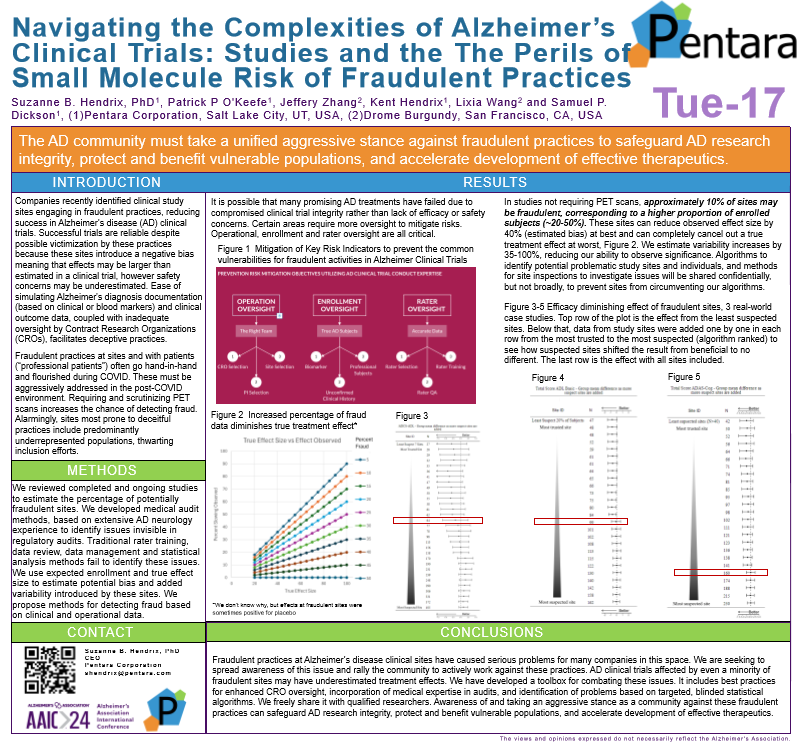
    Navigating the Complexities of Alzheimer's Clinical Trials: The Perils of Small Molecule Studies and the Risk of Fraudulent Practices

    Hendrix, Suzanne · O'Keefe, Patrick · Hendrix, Kent · Dickson, Samuel

    Abstract

    Background: Companies recently identified clinical study sites engaging in fraudulent practices, reducing success in Alzheimer's disease (AD) clinical trials. Successful trials are reliable despite possible victimization by these practices because these sites introduce a negative bias, meaning that effects may be larger than estimated in a clinical trial; however, safety concerns may be underestimated. Ease of simulating Alzheimer's diagnosis documentation (based on clinical or blood markers) and clinical outcome data, coupled with inadequate oversight by Contract Research Organizations (CROs), facilitates deceptive practices. Fraudulent practices at sites and with patients ("professional patients") often go hand-in-hand and flourished during COVID, and must be aggressively addressed in the post-COVID environment. Requiring and scrutinizing PET scans increases the chance of detecting fraud. Alarmingly, sites most prone to deceitful practices include predominantly underrepresented populations, thwarting inclusion efforts. Methods: We reviewed completed and ongoing studies to estimate the percentage of potentially fraudulent sites. We developed medical audit methods, based on extensive AD neurology experience, to identify issues invisible in regulatory audits; traditional rater training, data review, data management and statistical analysis methods fail to identify these issues. We use expected enrollment and true effect size to estimate potential bias and added variability introduced by these sites, and we propose methods for detecting fraud based on clinical and operational data. Results: In studies not requiring PET scans, approximately 10% of sites may be fraudulent, corresponding to a higher proportion of enrolled subjects (~20-50%). These sites can reduce observed effect size by 40% (estimated bias) at best and can completely cancel out a true treatment effect at worst. We estimate variability increases by 35-100%, reducing our ability to observe significance. Algorithms to identify potentially problematic study sites and individuals, and methods for site inspections to investigate issues, are shared confidentially rather than broadly, to prevent sites from circumventing the algorithms. Conclusions: Fraudulent practices at Alzheimer's disease clinical sites have caused serious problems for many companies in this space. AD clinical trials affected by even a minority of fraudulent sites may have underestimated treatment effects. We have developed a toolbox for combating these issues, including best practices for enhanced CRO oversight, incorporation of medical expertise in audits, and identification of problems based on targeted, blinded statistical algorithms, and we freely share it with qualified researchers. The AD community must take a unified aggressive stance against fraudulent practices to safeguard AD research integrity, protect and benefit vulnerable populations, and accelerate development of effective therapeutics.

    View poster →
  20. 2024 · Front Neurol

    Safety, tolerability, and efficacy estimate of evoked gamma oscillation in mild to moderate Alzheimer's disease

    Nicodemus-Johnson, Jessie · Hendrix, Suzanne

    Abstract

    Background: Alzheimer's Disease (AD) is a multifactorial, progressive neurodegenerative disease that disrupts synaptic and neuronal activity and network oscillations. It is characterized by neuronal loss, brain atrophy and a decline in cognitive and functional abilities. Cognito's Evoked Gamma Therapy System provides an innovative approach for AD by inducing EEG-verified gamma oscillations through sensory stimulation. Prior research has shown promising disease-modifying effects in experimental AD models. The present study (NCT03556280: OVERTURE) evaluated the feasibly, safety and efficacy of evoked gamma oscillation treatment using Cognito's medical device (CogTx-001) in participants with mild to moderate AD. Methods: The present study was a randomized, double blind, sham-controlled, 6-months clinical trial in participants with mild to moderate AD. The trial enrolled 76 participants, aged 50 or older, who met the clinical criteria for AD with baseline MMSE scores between 14 and 26. Participants were randomly assigned 2:1 to receive self-administered daily, one-hour, therapy, evoking EEG-verified gamma oscillations or sham treatment. The CogTx-001 device was use at home with the help of a care partner, over 6 months. The primary outcome measures were safety, evaluated by physical and neurological exams and monthly assessments of adverse events (AEs) and MRI, and tolerability, measured by device use. Although the trial was not statistically powered to evaluate potential efficacy outcomes, primary and secondary clinical outcome measures included several cognitive and functional endpoints. Results: Total AEs were similar between groups, there were no unexpected serious treatment related AEs, and no serious treatment-emergent AEs that led to study discontinuation. MRI did not show Amyloid-Related Imaging Abnormalities (ARIA) in any study participant. High adherence rates (85-90%) were observed in sham and treatment participants. There was no statistical separation between active and sham arm participants in primary outcome measure of MADCOMS or secondary outcome measure of CDR-SB or ADAS-Cog14. However, some secondary outcome measures including ADCS-ADL, MMSE, and MRI whole brain volume demonstrated reduced progression in active compared to sham treated participants, that achieved nominal significance. Conclusion: Our results demonstrate that 1-h daily treatment with Cognito's Evoked Gamma Therapy System (CogTx-001) was safe and well-tolerated and demonstrated potential clinical benefits in mild to moderate AD. Clinical Trial Registration: www.ClinicalTrials.gov, identifier: NCT03556280.

    Open → (opens in a new tab)
  21. 2023 · EBioMedicine

    Safety, tolerability, immunogenicity, and efficacy of UB-311 in participants with mild Alzheimer's disease: a randomised, double-blind, placebo-controlled, phase 2a study

    Dickson, Samuel · Hendrix, Suzanne

    Abstract

    Background: Anti-amyloid vaccines may offer a convenient, affordable, and accessible means of preventing and treating Alzheimer's disease. UB-311 is an anti-amyloid-β active immunotherapeutic vaccine shown to be well-tolerated and to have a durable antibody response in a phase 1 trial. This phase 2a study assessed the safety, immunogenicity, and preliminary efficacy of UB-311 in participants with mild Alzheimer's disease. Methods: A 78-week, randomised, double-blind, placebo-controlled, parallel-group, multicentre, phase 2a study was conducted in Taiwan. Participants were randomised in a 1:1:1 ratio to receive seven intramuscular injections of UB-311 (Q3M arm), or five doses of U311 with two doses of placebo (Q6M arm), or seven doses of placebo (placebo arm). The primary endpoints were safety, tolerability, and immunogenicity of UB-311. Safety was assessed in all participants who received at least one dose of investigational product. This study was registered at ClinicalTrials.gov (NCT02551809). Findings: Between 7 December 2015 and 28 August 2018, 43 participants were randomised. UB-311 was safe, well-tolerated, and generated a robust immune response. The three treatment-emergent adverse events (TEAEs) with the highest incidence were injection-site pain (14 TEAEs in seven [16%] participants), amyloid-related imaging abnormality with microhaemorrhages and haemosiderin deposits (12 TEAEs in six [14%] participants), and diarrhoea (five TEAEs in five [12%] participants). A 97% antibody response rate was observed and maintained at 93% by the end of the study across both UB-311 arms. Interpretation: These results support the continued development of UB-311.

    Open → (opens in a new tab)
  22. 2023 · Alzheimers Res Ther

    Avoiding future controversies in the Alzheimer's disease space through understanding the aducanumab data and FDA review

    Dickson, Samuel · Hennessey, Sean · Nicodemus-Johnson, Jessie · Knowlton, Newman · Hendrix, Suzanne

    Abstract

    Key points of disagreement between the aducanumab FDA statistical review, which had primarily negative conclusions, and the clinical review, which had primarily positive conclusions, were investigated. Results from secondary endpoints in positive Study 302 were significant and these endpoints provided meaningful additional information. Findings indicate the statistical review of the aducanumab data was incorrect in a number of key areas. Greater placebo decline was not responsible for the significant results in Study 302. Correlations did exist between reduction in β-amyloid and clinical outcomes. Missing data and functional unblinding did not likely bias results. In contrast, the clinical review went too far in saying the negative results in Study 301 did not detract from the positive results in Study 302, as all clinical data should be considered in the evaluation, and the clinical review accepted the company's explanation for divergence of the results between the studies although much of the divergence remained unexplained. Interestingly, both the statistical review and the clinical review considered the available efficacy evidence despite both studies being terminated early. Implications of these findings include that the divergence in results seen in the two phase 3 aducanumab studies can be expected in other studies with similar design and analysis. Therefore, further research is needed to determine if analysis methods other than MMRM and/or optimized outcomes will provide more consistent results across studies.

    Open → (opens in a new tab)
  23. 2023 · medRxiv

    Safety, Tolerability and Efficacy of 40 Hz Sensory Stimulation for Alzheimers Disease

    Nicodemus-Johnson, Jessie · Hendrix, Suzanne

    Abstract

    Alzheimer’s Disease (AD) is a multifactorial, progressive neurodegenerative disease that disrupts cognitive function through maladaptive misfolded proteins, abnormal neuroimmune responses, and disordered neuronal network activities. Despite continued scientific advances in the understanding of AD biology, there remains an unmet need for safe and effective disease-modifying treatments. Sensory stimulation is an emerging therapeutic approach which has demonstrated disease-modifying effects in preclinical transgenic models of AD. This randomized, sham-controlled, clinical trial (OVERTURE; NCT03556280) evaluated the feasibility and safety of 40Hz auditory and visual stimulation with the CogTx-001 medical device in 70 participants with mild to moderate AD, administered as daily, 1-hour active stimulation (as compared to sham stimulation) over a 6-month period. Primary endpoints of the therapy showed that it was well-tolerated, showed high adherence and demonstrated a favorable safety profile. Secondary outcomes included exploratory outcomes measures such as ADCS-ADL and MMSE scores, which demonstrated significant effects on functional and cognitive abilities. Additionally, sensory stimulation also showed a significant reduction in brain volume loss and cortical thinning, without changes in amyloid PET signal in active versus sham groups. These encouraging results justify further development of 40Hz sensory stimulation as a safe and potentially disease-modifying therapy for AD patients.

    Open → (opens in a new tab)
  24. 2022 · Neurology

    Safety of a Fixed-Dose Coformulation of Sodium Phenylbutyrate and Taurursodiol in Amyotrophic Lateral Sclerosis and Alzheimer's Disease: Integrated Clinical Trials Experience (S11. 005)

    Hendrix, Suzanne · Nicodemus-Johnson, Jessie · Dickson, Samuel · Knowlton, Newman

    Abstract

    Objective: Safety and tolerability of an oral, fixed-dose sodium phenylbutyrate/taurursodiol (PB/TURSO) coformulation were assessed in phase 2 trials in amyotrophic lateral sclerosis (ALS) and Alzheimer’s disease (AD). Background: PB/TURSO was designed to reduce neurodegeneration by targeting endoplasmic reticulum and mitochondrial stress, both implicated in the pathophysiology of ALS and AD. Design/Methods: In the AMX-3500 Study (CENTAUR) in ALS, participants (PB/TURSO, n=89; placebo, n=48) completing the 24-week randomized phase (NCT03127514) were eligible to enroll in an open-label extension (OLE) phase (NCT03488524) and receive PB/TURSO (≤132 weeks, week 24 reported). Study AMX-8000 (PEGASUS; NCT03533257) was a 24-week randomized trial in adults with AD or mild cognitive impairment (PB/TURSO, n=51; placebo, n=44). PB/TURSO safety and tolerability was the primary objective of both trials. Results: Mean (SD) ages were 57.7 (9.6) and 70.7 (7.5) years in CENTAUR and PEGASUS, respectively. Treatment-emergent adverse event (TEAE) incidence was similar between groups in the CENTAUR randomized phase (PB/TURSO, 97%; placebo, 96%); 77% reported ≥1 TEAEs in the OLE phase. In PEGASUS, TEAEs occurred in 67% and 59% of the PB/TURSO and placebo groups, respectively. Gastrointestinal TEAEs were more frequent during initial PB/TURSO exposure (week ≤3) in CENTAUR and accounted for the predominance of PB/TURSO-related TEAEs in PEGASUS. Incidence of cardiac events with PB/TURSO was low (CENTAUR, 8%; PEGASUS, 4%), and in both studies, electrocardiographic findings were similar between groups at baseline, with no clinically meaningful changes observed over the course of treatment. Conclusions: These findings support the PB/TURSO safety profile in ALS and AD. TEAE incidence was generally similar between PB/TURSO and placebo in both trials. PB/TURSO-associated TEAEs were mostly gastrointestinal, consistent with the known profiles for PB and TURSO. Findings in AD further elucidate the PB/TURSO safety profile, as TEAEs in CENTAUR appear to have been largely disease driven. An updated safety analysis (pooled and OLE data) will be presented.

    Open → (opens in a new tab)
  25. 2022 · Neurology

    Feasibility, Safety, and Efficacy of Gamma Sensory Stimulation as a Novel Therapeutic Intervention for Alzheimer's Disease (N1. 001)

    Nicodemus-Johnson, Jessie · Hendrix, Suzanne

    Abstract

    Objective: To evaluate the safety, tolerability, adherence, and efficacy of 40Hz sensory stimulation therapy in subjects with Alzheimer’s disease (AD). Background: 40Hz gamma sensory stimulation diminishes AD pathology, neurodegeneration, and brain atrophy, synaptic and learning dysfunctions in transgenic mice carrying AD-related human pathological genes (Adaikkan & Tsai, 2020). These results initiated the development and validation of non-invasive, gamma sensory stimulation as a potential therapeutic for AD treatment. Design/Methods: Participants on AD spectrum were randomized to receive daily, one-hour, EEG-calibrated, noninvasive audio-visual stimulation, or sham stimulation in a 6-month clinical trial (Overture trial; NCT03556280) using Cognito Therapeutics medical device. Both safety (MRI, physical and neurological exams), and efficacy (AD cognitive and functional instruments, volumetric MRI) were assessed. Results: A total of 135 subjects were screened, 74 were randomized, and 53 completed the trial. The rate of AEs during the trial were roughly equivalent between groups. There were no unexpected serious treatment adverse events. Over the 6-month treatment period, changes in ADCS-ADL scores were significantly better in the treatment group compared to sham, indicating a 78% slowing in functional decline (P<0.0003). Similarly, the treatment group demonstrated a statistically significant 83% (p<0.013) reduction in cognitive decline, shown by changes in MMSE scores. The outcomes of MADCOMs, ADAS-cog14 and CDR-sb were not statistically different between groups. Quantitative MRI analysis revealed that whole brain volume loss in the treatment group demonstrated a significant, 72% reduction in brain atrophy (p<0.01) compared to sham group. Reduced lateral ventricle enlargement and diminished loss in cortical thickness in the occipital cortex have been also observed. MRI data demonstrated absence of ARIA in all subjects. Conclusions: Long-term, daily, self-administered, home-use of gamma sensory stimulation is both safe and well tolerated in AD subjects. Patients given gamma stimulation therapy maintained cognitive and functional abilities. Gamma sensory stimulation reduced brain atrophy, indicating potential disease-modifying effects in AD.

    Open → (opens in a new tab)
  26. 2021 · Alzheimer's & Dementia: Translational Research & Clinical Interventions

    GenoRisk: A polygenic risk score for Alzheimer's disease

    Dickson, Samuel · Hendrix, Suzanne · Brown, Bruce · Nicodemus-Johnson, Jessie

    Open → (opens in a new tab)
  27. 2020 · Alzheimer's & Dementia

    Combining evidence across multiple endpoints with a global statistical test: Comparison of z-scores versus ranks

    Dickson, Samuel · Knowlton, Newman · Hendrix, Suzanne

    Abstract

    Background: Alzheimer’s disease (AD) is a multi-symptom disease which has cognitive, behavioral, functional and global outcomes. These outcomes are all important measures of disease severity and are driven by the underlying disease process. These symptoms provide multiple, potentially conflicting, answers to the question, “Did the treatment work?” Method: Outcomes can be combined through standardization of outcomes using ranks or z-scores. Additionally, the standardization can be performed before calculating change from baseline or after. These four combinations are explored by simulations with no effect, corroborative effects across outcomes, and disparate effects across outcomes (a mix of positive and null effects) to demonstrate the type I error (no effect) and power under various secenarios along with other performance metrics. Result: All four methods of calculating a GST adequately control type I error. In the absence of ceiling and floor effects, the GST that calculates change from baseline first then combines evidence using z-scores has the highest power. In the presence of disparate effects, the GST can still be more powerful than any single outcome, though the effect is appropriately attenuated. The GSTs that use ranking outperform z-score methods in the presence of strong floor or ceiling effects. Conclusion: A clinical trial with a GST analyzed first can show success as a proof of concept even if the individual outcomes fail to achieve significance, signalling that a development can proceed to later phases. Change from baseline should be calculated first. If there are no ceiling or floor effects, standardization should be performed using z-scores, otherwise percentiles should be used. GSTs offer a good way to combine outcomes to demonstrate efficacy using fewer subjects.

    Open → (opens in a new tab)
  28. 2020 · Alzheimer's & Dementia

    In a pre-pivotal diagnostic study, β-amyloid plaque detection in the lens of the eye in MCI and mild AD patients was used to classify subjects as normal, MCI, and mild AD using Sapphire II

    Knowlton, Newman · Hendrix, Suzanne

    Abstract

    Background: The Sapphire II platform is a clinical diagnostic device intended for aiding clinical evaluation and measurement of beta-amyloid aggregation in anatomically defined regions of the anterior segment of the eye. It detects a specific fluorescent signature emission of ligand-marked beta amyloid complex in the supranuclear region of the human lens. The current study results are Sapphire II scan to be used to classify patients as normal, MCI and mild Alzheimer’s disease and the utility of Sapphire II screening compared to b-amyloid PET scans in MCI and Mild AD subjects. Method: A naïve Bayes classifier using a base model with the three most theoretically relevant parameters (τ1, τ2, φ). Sensitivity and specificity is assessed comparing the normal group to the collective MCI/Mild AD group. 48 participants; 28 MCI, 16 Mild AD patients and 4 Normal Control subjects were studied. Results: The Sapphire II naïve Bayes classifier with cross validation had sensitivity of 96%, specificity of 75%, and overall accuracy of 92%. Results based on 4 healthy controls only, with one of the control subjects tested positive in Sapphire II; additional testing on 10 healthy controls is in progress. Conclusion: Sapphire II offers a non-invasive, safe, easy to use, community based inexpensive method for accurately classifying individuals as normal, MCI or mild AD dementia on the basis of the beta amyloid in the lens of the eye. Sapphire II may offer a practical alternative to PET amyloid scans for biomarker confirmed AD diagnosis. Evaluation of individual PET scans and cognitive testing suggests that Sapphire II is more sensitive than PET.

    Open → (opens in a new tab)
  29. 2020 · Alzheimer's & Dementia

    Complementary analyses of the AMBAR trial: Impact of discontinuations, consistency of results across outcomes and additional adjustments

    Hendrix, Suzanne

    Abstract

    Background The AMBAR study enrolled 496 mild-to-moderate Alzheimer’s disease (AD) patients from Spain and US centers, 347 of which were randomized [1:1:1:1] to three treatment arms of plasma exchange (PE) with different doses of albumin with or without intravenous immunoglobulin (IVIG) or placebo (sham PE) arm. PE treatment showed slow cognitive and functional decline in AD patients, with variable significance in outcome (primary: ADCS-ADL, ADAS-Cog; secondary: CDR-Sb, ADCS-CGIC), baseline disease severity, and treatment arm (low-albumin; low-albumin+IVIG, high-albumin+IVIG, and all three combined). The percentage of patient dropouts ranged from 20% in the placebo to 34.9% in the low-albumin+IVIG group. In this analysis we investigated the effect of possible biases due to discontinuations and baseline imbalances, and assessed the consistency across outcomes. Method The impact of discontinuations was determined by least squares mean estimates from the Mixed Model for Repeated Measures (MMRM) analysis using the z-score carried forward analysis (zLOCF). The overall impact of the treatment on the disease was determined by a global statistical test which combined with equal weighting three outcomes (ADCS-ADL, ADAS-Cog, CDR-Sb) into a single outcome. An analysis of relevant outcomes was performed adjusting for key baseline characteristics. Result Analysis of discontinuations suggested that the treatment differences and effect sizes estimated using the primary model MMRM are likely to be conservative and that lowering dropouts is likely to increase effect sizes. Effect sizes were consistent across outcomes (between 51% and 76%). The GST score showed slowing of progression at month 14 with statistically significant differences between all active treatments and placebo from month 9 onward. When the model was adjusted for key baseline characteristics, the analysis showed statistically significant differences against placebo of all treatment groups in most of the relevant outcomes. Conclusion Results of this analysis disprove the possible bias of dropout effect in the AMBAR trial. Effect sizes were consistent across outcomes and the Global Statistical Test showed an overall impact of the treatment on the disease. The analysis corrected for baseline factors supports and reinforces the findings that the PE-treated arms were superior to the placebo group.

    Open → (opens in a new tab)
  30. 2020 · 2020 Alzheimer's Association International Conference

    The impact of a nutritional intervention in prodromal Alzheimer's disease: The LipiDiDiet clinical trial

    Hendrix, Suzanne

    Abstract

    Background: Diet and nutrition are important modifiable risk factors for Alzheimer’s disease (AD). For the last two decades, the LipiDiDiet consortium has been investigating the role of nutrients and their synergistic action on key AD pathological features. Based on preclinical results, 11 nutrients were selected which, when applied in this specific combination, gave the best results in rodent AD models: i.e. the omega-3 fatty acids DHA and EPA, phospholipids, vitamins B6, B12, folic acid, C and E, choline, selenium, and UMP. The LipiDiDiet trial1 is a 6-year, double-blind, parallel-group, multi-centre, randomised controlled clinical trial, designed to investigate effects of the specific multinutrient combination Fortasyn Connect on cognition and related measures in prodromal AD. Initial 24 month results showed significant benefit on clinical dementia rating-sum of boxes (CDR-SB) and hippocampal and ventricular volumes in the modified intention-to-treat population. Here we report previously specified primary and secondary outcomes over 36 months of intervention. Method: Prodromal AD participants (n=311) were randomised to receive either active product (125 mL drink containing Fortasyn Connect) or a calorie-matched placebo control once daily. Result: 162 participants completed the 36-month period. With increasing treatment duration, the benefit of the active group over the control group exceeded what had been observed for the first 24 months (Soininen et al., Lancet Neurology 2017). For the 5-item neuropsychological test battery (NTB) on cognition, a significant between-group difference was observed in estimated mean change from baseline over 36 months favouring active intervention (0.212 [95% CI 0.044 to 0.380]; p=0.014; 60% reduction in decline). In addition, significant benefits were found on CDR-SB, NTB memory, and hippocampal, ventricular, and whole brain volumes on MRI. Self-reported compliance to the study product was high and there was no indication of safety concern. Conclusion: We observed significantly slower decline in cognition including memory, CDR-SB measuring cognition and function, and brain structural measures. Importantly, prolonged intervention with this specific combination of nutrients resulted in a broader range of endpoints showing statistically significant differences. Sustainable benefits lasting for 3 or more years have not been reported before in prodromal AD.

    Open → (opens in a new tab)
  31. 2019 · Journal of the American Medical Directors Association

    Cognitive Outcomes of Long-term Benzodiazepine and Related Drug (BDZR) Use in People Living With Mild to Moderate Alzheimer's Disease: Results From NILVAD

    Hendrix, Suzanne

    Abstract

    Objective Benzodiazepines and related drugs (BDZRs) have been associated with an increased risk of Alzheimer's disease (AD) in later life. Despite this, it remains unclear whether ongoing BDZR use may further accelerate cognitive decline in those diagnosed with mild to moderate AD. Design This study was embedded within NILVAD, a randomized controlled trial of nilvadipine in mild to moderate AD. Cognition was measured at baseline and 18 months using the Alzheimer Disease Assessment Scale, Cognitive Subsection (ADAS-Cog). We assessed predictors of long-term BDZR use and analyzed the effect of ongoing BDZR use on ADAS-Cog scores at 18 months. Additionally, the impact of BDZR use on adverse events, incident delirium, and falls over 18-month follow-up was assessed adjusting for relevant covariates. Setting and Participants 448 participants with mild to moderate AD recruited from 23 academic centers in 9 European countries. Results Overall, 14% (62/448) were prescribed an ongoing BDZR for the study duration. Increasing total number of (non-BDZR) medications was associated with a greater likelihood of BDZR prescription (odds ratio 1.16, 95% confidence interval 1.05-1.29). At 18 months, BDZR use was not associated with greater cognitive decline on the ADAS-Cog controlling for baseline ADAS-Cog scores, age, gender, study arm, and other clinical covariates (β = 1.62, −1.34 to 4.56). However, ongoing BDZR use was associated with a greater likelihood of adverse events [incidence rate ratio (IRR) 1.19, 1.05-1.34], incident delirium (IRR 2.31, 1.45-3.68), and falls (IRR 1.66, 1.02-2.65) over 18 months that persisted after robust adjustment for covariates. Conclusions and Implications This study found no effect of ongoing BDZR use on ADAS-Cog scores in those with mild to moderate AD over 18 months. However, ongoing use of these medications was associated with an increased risk of adverse events, delirium, and falls. Thus, BDZR use should be avoided where possible and deprescribing interventions should be encouraged in older adults with AD.

    Open → (opens in a new tab)
  32. 2019 · The Journal of Prevention of Alzheimer's Disease

    Alzheimer's disease composite score: a post-hoc analysis using data from the LipiDiDiet trial in prodromal Alzheimer's disease

    Hendrix, Suzanne

    Abstract

    As research evolves in prodromal AD, the need to validate sufficiently sensitive outcome measures, e.g. the Alzheimer's Disease Composite Score (ADCOMS) is clear. In the LipiDiDiet randomized trial in prodromal AD, cognitive decline in the study population was much less than expected in the timeframe studied. While the primary composite endpoint was insufficiently sensitive to detect a difference in the modified intention to treat population, the per-protocol population showed less decline in the active than the control group, indicating better treatment effects with regular product intake. These results were further strengthened by significant benefits on secondary endpoints of cognition and function, and brain atrophy. The present post-hoc analysis investigated whether ADCOMS could detect a difference between groups in the LipiDiDiet population (138 active, 140 control). The estimated mean change in ADCOMS from baseline (standard error) was 0.085 (0.018) in the active and 0.133 (0.018) in the control group; estimated mean treatment difference −0.048 (95% confidence intervals −0.090, −0.007; p=0.023), or 36% less decline in the active group. This suggests ADCOMS identified the cognitive and functional benefits observed previously, confirming the sensitivity of this composite measure.

    Open → (opens in a new tab)

Looking for older work, or a specific methodology paper? Our research team can point you to the right reference.

Ask our team