+ Abstract
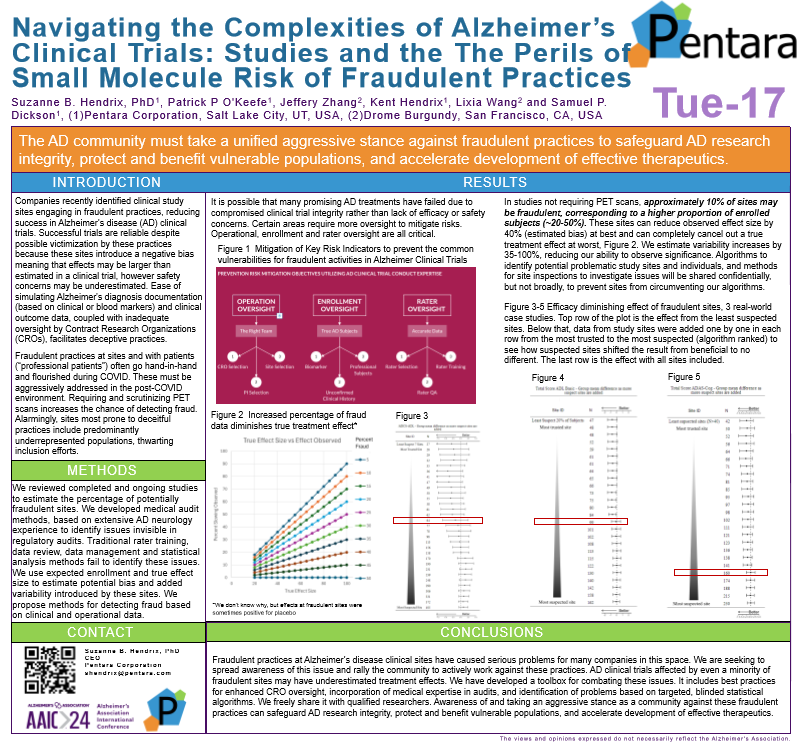
Background: Companies recently identified clinical study sites engaging in fraudulent practices, reducing success in Alzheimer's disease (AD) clinical trials. Successful trials are reliable despite possible victimization by these practices because these sites introduce a negative bias, meaning that effects may be larger than estimated in a clinical trial; however, safety concerns may be underestimated. Ease of simulating Alzheimer's diagnosis documentation (based on clinical or blood markers) and clinical outcome data, coupled with inadequate oversight by Contract Research Organizations (CROs), facilitates deceptive practices. Fraudulent practices at sites and with patients ("professional patients") often go hand-in-hand and flourished during COVID, and must be aggressively addressed in the post-COVID environment. Requiring and scrutinizing PET scans increases the chance of detecting fraud. Alarmingly, sites most prone to deceitful practices include predominantly underrepresented populations, thwarting inclusion efforts. Methods: We reviewed completed and ongoing studies to estimate the percentage of potentially fraudulent sites. We developed medical audit methods, based on extensive AD neurology experience, to identify issues invisible in regulatory audits; traditional rater training, data review, data management and statistical analysis methods fail to identify these issues. We use expected enrollment and true effect size to estimate potential bias and added variability introduced by these sites, and we propose methods for detecting fraud based on clinical and operational data. Results: In studies not requiring PET scans, approximately 10% of sites may be fraudulent, corresponding to a higher proportion of enrolled subjects (~20-50%). These sites can reduce observed effect size by 40% (estimated bias) at best and can completely cancel out a true treatment effect at worst. We estimate variability increases by 35-100%, reducing our ability to observe significance. Algorithms to identify potentially problematic study sites and individuals, and methods for site inspections to investigate issues, are shared confidentially rather than broadly, to prevent sites from circumventing the algorithms. Conclusions: Fraudulent practices at Alzheimer's disease clinical sites have caused serious problems for many companies in this space. AD clinical trials affected by even a minority of fraudulent sites may have underestimated treatment effects. We have developed a toolbox for combating these issues, including best practices for enhanced CRO oversight, incorporation of medical expertise in audits, and identification of problems based on targeted, blinded statistical algorithms, and we freely share it with qualified researchers. The AD community must take a unified aggressive stance against fraudulent practices to safeguard AD research integrity, protect and benefit vulnerable populations, and accelerate development of effective therapeutics.