Pentara® logo

Publications

Over 200 publications, including the composite endpoints regulators now recognize. We publish our methodology in the open so reviewers meet it before your submission does.

200+
Publications
1996–2026
Span
28
Contributing authors
White paper

Global Statistical Tests: powering the trial your budget can actually fund

When the sample size a conventional design demands is larger than the trial you can run, a Global Statistical Test lets the clinical-endpoint hypotheses be tested anyway. The paper sets out when GST applies, how it is pre-specified, and how it has been received in review.

One email with the PDF. No sequence, no follow-up unless you ask for one. We use your details only to send it; see our Privacy Policy.

Research

Publications library

33 publications

Sorted newest first

  1. 2026 · Stroke Vasc Interv Neurol

    RNS60 RESCUE Trial in Acute Ischemic Stroke: Post Hoc Analysis in Participants Enrolled <12 Hours Since Last Known Well

    Nicodemus-Johnson, Jessie · Anderson, Landon

    Abstract · matched in abstract

    Background: Adjunct therapies are needed for patients with acute ischemic stroke who fare poorly, despite standard-of-care endovascular thrombectomy (EVT). RESCUE (A Randomized, Blinded, Placebo-Controlled, Parallel Group Design to Determine the Safety of RNS60 in Large Vessel Occlusion Stroke Patients Undergoing Endovascular Thrombectomy) tested the cytoprotective experimental drug RNS60 in patients with acute ischemic stroke, adjunct to EVT with or without prior standard-of-care thrombolytic treatment. Methods: RESCUE, a randomized, placebo-controlled, double-blind, phase 2 study, enrolled 83 participants eligible for EVT within 24 hours since last known well, assigned 1:1:1 to 48-hour infusion of RNS60 0.5 mL/kg per hour, RNS60 1.0 mL/kg per hour, or placebo 1.0 mL/kg per hour. A post hoc analysis evaluated safety and efficacy in a subpopulation of 62 participants enrolled within 12 hours since last known well. Efficacy end points included modified Rankin Scale score, post-EVT infarct growth, National Institutes of Health Stroke Scale score, Barthel Index score, EuroQoL, and duration of hospitalization and discharge disposition. Results: In this subpopulation, RNS60 1.0 mL/kg per hour was generally safe and well tolerated and reduced post-EVT infarct growth compared with placebo (least squares mean difference, 22.2; P=0.05). Of the participants treated with RNS60 1.0 mL/kg per hour, 72.2% achieved a 90-day modified Rankin Scale score of 0 to 2, and 72.2% achieved a Barthel Index score ≥95, compared with 36.8% (for both measures) of those receiving placebo, although the differences were not statistically significant (P=0.09 for both modified Rankin Scale and Barthel Index scores). Consistent but smaller differences to placebo were seen in the RNS60 0.5 mL/kg per hour group, which suggests a dose-dependent effect of RNS60. Participants in the RNS60 1.0 mL/kg per hour group were also released earlier from the hospital than those in the placebo group (mean [SD]: 6.0 [5.10] days versus 10.8 [6.84] days; mean difference [SE], -4.8 [1.99]; P=0.02). Final infarct volumes at 48 hours post-EVT correlated with modified Rankin Scale scores at day 90 for RNS60 1.0 mL/kg per (Pearson r=0.65; P=0.005) and placebo (r=0.65; P=0.007). Conclusions: Effects of RNS60 were favorable compared with placebo in the analyzed subpopulation, warranting further investigation in this population.

    Open → (opens in a new tab)
  2. 2026 · Nat Med

    Target product profiles for treatments to delay or prevent symptomatic Alzheimer's disease

    Hendrix, Suzanne

    Abstract · matched in abstract

    Despite advances in understanding the mechanisms, risk factors and treatment strategies for Alzheimer's disease (AD), no approved therapies exist to prevent or delay onset in at-risk individuals or those with elevated biomarkers who do not yet show symptoms. Multiple candidate interventions are now being evaluated in clinical trials in these settings, raising key questions around which populations are most appropriate and what criteria should guide regulatory and clinical decision-making. Data are expected within 1-2 years, underscoring the need for stakeholder alignment on clinically meaningful and acceptable characteristics of preventative therapies or other products. To address this need, the Global CEO Initiative on Alzheimer's Disease convened an international group of experts to develop target product profiles for therapies designed to delay or prevent the onset of clinical symptoms in AD. These target product profiles outline minimum and preferred characteristics, including intended use, target populations, safety expectations and efficacy benchmarks. This effort provides a foundational framework to accelerate therapeutic development and guide researchers, regulators and patients in the evaluation of emerging therapies for preventing symptomatic AD.

    Open → (opens in a new tab)
  3. 2025 · Neurotherapeutics

    Evaluation of exploratory fluid biomarkers from a phase 1 senolytic trial in mild Alzheimer's disease

    Johnson, Sam · Hendrix, Suzanne

    Abstract · matched in abstract

    Senescent cell accumulation contributes to the progression of age-related disorders including Alzheimer's disease (AD). Clinical trials focused on cellular senescence are in early stages and have yet to establish reliable outcome measures reflecting senescent cell burden or response to senolytics, therapeutics that clear senescent cells. Results from the first open-label trial of senolytics, dasatinib plus quercetin (D ​+ ​Q), in older adults (N ​= ​5) with early AD demonstrated central nervous system penetration of dasatinib and favorable safety and tolerability. Herein, we present exploratory analyses of senescence and AD-associated analytes in blood, cerebrospinal fluid (CSF) and urine from this study in effort to guide biomarker development for future senolytic trials. Immunoassays, mass spectrometry and transcriptomics were performed and changes in analyte levels were assessed from baseline to post-treatment using paired t-tests. Targeted cytokine and chemokine analyses revealed increases in plasma fractalkine and MMP-7 and CSF IL-6 from baseline to post-treatment. Mass spectrometry indicated stable levels of amyloid β and tau proteins in CSF, unchanged urinary metabolites, and modest treatment-associated lipid profile changes. Targeted transcriptomic analysis of peripheral blood mononuclear cells indicated downregulation of inflammatory genes including FOS, FOSB, IL1β, IL8, JUN, JUNB, PTGS2. The levels and treatment responses of the analytes identified here may help inform trial design and outcomes for senolytic studies. Independent validation will be necessary to develop standardized biomarker panels across senolytic trials for AD. ClinicalTrials.gov: NCT04063124.

    Open → (opens in a new tab)
  4. 2025 · NEJM Evid

    Safety and Efficacy of Senolytic UBX1325 in Diabetic Macular Edema

    Mallinckrodt, Craig

    Abstract

    Background: We tested the ability of a single intravitreal injection of foselutoclax (hereafter UBX1325), a novel senolytic small molecule inhibitor of antiapoptotic protein B-cell lymphoma-extra large, to mitigate the impact of diabetic macular edema. Methods: Patients with diabetic macular edema with prior suboptimal response to anti-vascular endothelial growth factor treatment were randomly assigned (1:1) to either a single intravitreal injection of 10 μg of UBX1325 or sham and were followed for up to 48 weeks. The primary trial objective was to evaluate the safety and side-effect profile of UBX1325 as assessed by ocular and systemic treatment-emergent adverse events (TEAEs). Our secondary objective was to probe efficacy, defined as mean changes from baseline for UBX1325 versus sham in best corrected visual acuity measured in Early Treatment of Diabetic Retinopathy Study (ETDRS) letters (range, 0-100 letters, higher scores indicate better vision) and retinal structure. Results: Between June 2021 and April 2022, 65 participants (32.3% women) were randomly assigned to either UBX1325 (n=32) or sham (n=33). There were four TEAEs of Grade 3 or greater in the sham group, of which three were considered serious, while there were five in the UBX1325 group of Grade 3 or greater and considered serious. There were no apparent between-group differences with respect to vital signs, electrocardiograms, or routine blood chemistries. For the secondary outcome of efficacy, the difference between UBX1325 and sham in mean change to week 48 in best corrected visual acuity was 5.6 more ETDRS letters (95% confidence interval, -1.5 to 12.7). Conclusions: In this sham-controlled trial there were no TEAEs that led to discontinuation of treatment with UBX1325 compared with sham. There were trends suggestive of potential efficacy; larger trials are needed to further evaluate these findings. (Funded by UNITY Biotechnology; ClinicalTrials.gov number, NCT04857996.).

    Open → (opens in a new tab)
  5. 2025 · J Prev Alzheimers Dis

    Donanemab: Appropriate use recommendations

    Hendrix, Suzanne

    Abstract · matched in abstract

    Donanemab (Kisunla®), an IgG1 monoclonal antibody targeting N-terminal pyroglutamate-modified forms of amyloid-β, is approved in the United States for treatment of early symptomatic Alzheimer's disease (AD). Appropriate Use Recommendations (AUR) were developed to guide the implementation of donanemab in real-world practice, prioritizing safety considerations and opportunity for effectiveness. The AUR were developed by the AD and Related Disorders Therapeutic Workgroup by consensus, integrating available data and expert opinion. Appropriate candidates for donanemab treatment include persons with mild cognitive impairment or mild dementia due to AD (Clinical Stages 3-4, MMSE 20-30) who have biomarker confirmation of AD pathology by PET or CSF. Tau PET is not required for eligibility. Apolipoprotein E (APOE) genotyping should be performed prior to treatment to inform an individual's risk of developing Amyloid-Related Imaging Abnormalities (ARIA). Pre-treatment MRI should be obtained no more than 12 months prior to treatment. Patients with findings of >4 cerebral microbleeds, cortical superficial siderosis or a major vascular contribution to cognitive impairment should be excluded from treatment. The decision to initiate therapy should be grounded in a shared decision-making process that emphasizes the patient's values and goals of care. Donanemab is administered as a monthly intravenous infusion. Surveillance MRIs to evaluate for ARIA should be performed prior to the 2nd, 3rd, 4th and 7th infusions, prior to the 12th dose in higher risk individuals, and at any time ARIA is suspected clinically. Clinicians may consider discontinuing treatment if amyloid clearance is demonstrated by amyloid PET, typically obtained 12-18 months after initiating treatment.

    Open → (opens in a new tab)
  6. 2024 · Alzheimer's Association International Conference (AAIC)

    Navigating the Complexities of Alzheimer's Clinical Trials: The Perils of Small Molecule Studies and the Risk of Fraudulent Practices

    Hendrix, Suzanne · O'Keefe, Patrick · Hendrix, Kent · Dickson, Samuel

    Abstract · matched in abstract

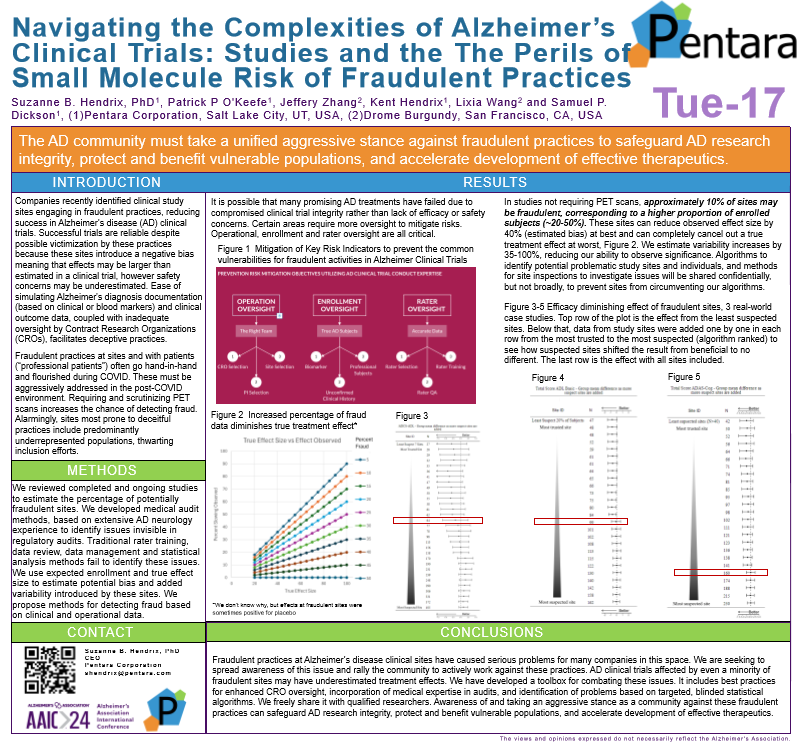
    Background: Companies recently identified clinical study sites engaging in fraudulent practices, reducing success in Alzheimer's disease (AD) clinical trials. Successful trials are reliable despite possible victimization by these practices because these sites introduce a negative bias, meaning that effects may be larger than estimated in a clinical trial; however, safety concerns may be underestimated. Ease of simulating Alzheimer's diagnosis documentation (based on clinical or blood markers) and clinical outcome data, coupled with inadequate oversight by Contract Research Organizations (CROs), facilitates deceptive practices. Fraudulent practices at sites and with patients ("professional patients") often go hand-in-hand and flourished during COVID, and must be aggressively addressed in the post-COVID environment. Requiring and scrutinizing PET scans increases the chance of detecting fraud. Alarmingly, sites most prone to deceitful practices include predominantly underrepresented populations, thwarting inclusion efforts. Methods: We reviewed completed and ongoing studies to estimate the percentage of potentially fraudulent sites. We developed medical audit methods, based on extensive AD neurology experience, to identify issues invisible in regulatory audits; traditional rater training, data review, data management and statistical analysis methods fail to identify these issues. We use expected enrollment and true effect size to estimate potential bias and added variability introduced by these sites, and we propose methods for detecting fraud based on clinical and operational data. Results: In studies not requiring PET scans, approximately 10% of sites may be fraudulent, corresponding to a higher proportion of enrolled subjects (~20-50%). These sites can reduce observed effect size by 40% (estimated bias) at best and can completely cancel out a true treatment effect at worst. We estimate variability increases by 35-100%, reducing our ability to observe significance. Algorithms to identify potentially problematic study sites and individuals, and methods for site inspections to investigate issues, are shared confidentially rather than broadly, to prevent sites from circumventing the algorithms. Conclusions: Fraudulent practices at Alzheimer's disease clinical sites have caused serious problems for many companies in this space. AD clinical trials affected by even a minority of fraudulent sites may have underestimated treatment effects. We have developed a toolbox for combating these issues, including best practices for enhanced CRO oversight, incorporation of medical expertise in audits, and identification of problems based on targeted, blinded statistical algorithms, and we freely share it with qualified researchers. The AD community must take a unified aggressive stance against fraudulent practices to safeguard AD research integrity, protect and benefit vulnerable populations, and accelerate development of effective therapeutics.

    View poster →
  7. 2024 · Front Neurol

    Safety, tolerability, and efficacy estimate of evoked gamma oscillation in mild to moderate Alzheimer's disease

    Nicodemus-Johnson, Jessie · Hendrix, Suzanne

    Abstract

    Background: Alzheimer's Disease (AD) is a multifactorial, progressive neurodegenerative disease that disrupts synaptic and neuronal activity and network oscillations. It is characterized by neuronal loss, brain atrophy and a decline in cognitive and functional abilities. Cognito's Evoked Gamma Therapy System provides an innovative approach for AD by inducing EEG-verified gamma oscillations through sensory stimulation. Prior research has shown promising disease-modifying effects in experimental AD models. The present study (NCT03556280: OVERTURE) evaluated the feasibly, safety and efficacy of evoked gamma oscillation treatment using Cognito's medical device (CogTx-001) in participants with mild to moderate AD. Methods: The present study was a randomized, double blind, sham-controlled, 6-months clinical trial in participants with mild to moderate AD. The trial enrolled 76 participants, aged 50 or older, who met the clinical criteria for AD with baseline MMSE scores between 14 and 26. Participants were randomly assigned 2:1 to receive self-administered daily, one-hour, therapy, evoking EEG-verified gamma oscillations or sham treatment. The CogTx-001 device was use at home with the help of a care partner, over 6 months. The primary outcome measures were safety, evaluated by physical and neurological exams and monthly assessments of adverse events (AEs) and MRI, and tolerability, measured by device use. Although the trial was not statistically powered to evaluate potential efficacy outcomes, primary and secondary clinical outcome measures included several cognitive and functional endpoints. Results: Total AEs were similar between groups, there were no unexpected serious treatment related AEs, and no serious treatment-emergent AEs that led to study discontinuation. MRI did not show Amyloid-Related Imaging Abnormalities (ARIA) in any study participant. High adherence rates (85-90%) were observed in sham and treatment participants. There was no statistical separation between active and sham arm participants in primary outcome measure of MADCOMS or secondary outcome measure of CDR-SB or ADAS-Cog14. However, some secondary outcome measures including ADCS-ADL, MMSE, and MRI whole brain volume demonstrated reduced progression in active compared to sham treated participants, that achieved nominal significance. Conclusion: Our results demonstrate that 1-h daily treatment with Cognito's Evoked Gamma Therapy System (CogTx-001) was safe and well-tolerated and demonstrated potential clinical benefits in mild to moderate AD. Clinical Trial Registration: www.ClinicalTrials.gov, identifier: NCT03556280.

    Open → (opens in a new tab)
  8. 2023 · EBioMedicine

    Safety, tolerability, immunogenicity, and efficacy of UB-311 in participants with mild Alzheimer's disease: a randomised, double-blind, placebo-controlled, phase 2a study

    Dickson, Samuel · Hendrix, Suzanne

    Abstract

    Background: Anti-amyloid vaccines may offer a convenient, affordable, and accessible means of preventing and treating Alzheimer's disease. UB-311 is an anti-amyloid-β active immunotherapeutic vaccine shown to be well-tolerated and to have a durable antibody response in a phase 1 trial. This phase 2a study assessed the safety, immunogenicity, and preliminary efficacy of UB-311 in participants with mild Alzheimer's disease. Methods: A 78-week, randomised, double-blind, placebo-controlled, parallel-group, multicentre, phase 2a study was conducted in Taiwan. Participants were randomised in a 1:1:1 ratio to receive seven intramuscular injections of UB-311 (Q3M arm), or five doses of U311 with two doses of placebo (Q6M arm), or seven doses of placebo (placebo arm). The primary endpoints were safety, tolerability, and immunogenicity of UB-311. Safety was assessed in all participants who received at least one dose of investigational product. This study was registered at ClinicalTrials.gov (NCT02551809). Findings: Between 7 December 2015 and 28 August 2018, 43 participants were randomised. UB-311 was safe, well-tolerated, and generated a robust immune response. The three treatment-emergent adverse events (TEAEs) with the highest incidence were injection-site pain (14 TEAEs in seven [16%] participants), amyloid-related imaging abnormality with microhaemorrhages and haemosiderin deposits (12 TEAEs in six [14%] participants), and diarrhoea (five TEAEs in five [12%] participants). A 97% antibody response rate was observed and maintained at 93% by the end of the study across both UB-311 arms. Interpretation: These results support the continued development of UB-311.

    Open → (opens in a new tab)
  9. 2023 · medRxiv

    Safety, Tolerability and Efficacy of 40 Hz Sensory Stimulation for Alzheimers Disease

    Nicodemus-Johnson, Jessie · Hendrix, Suzanne

    Abstract

    Alzheimer’s Disease (AD) is a multifactorial, progressive neurodegenerative disease that disrupts cognitive function through maladaptive misfolded proteins, abnormal neuroimmune responses, and disordered neuronal network activities. Despite continued scientific advances in the understanding of AD biology, there remains an unmet need for safe and effective disease-modifying treatments. Sensory stimulation is an emerging therapeutic approach which has demonstrated disease-modifying effects in preclinical transgenic models of AD. This randomized, sham-controlled, clinical trial (OVERTURE; NCT03556280) evaluated the feasibility and safety of 40Hz auditory and visual stimulation with the CogTx-001 medical device in 70 participants with mild to moderate AD, administered as daily, 1-hour active stimulation (as compared to sham stimulation) over a 6-month period. Primary endpoints of the therapy showed that it was well-tolerated, showed high adherence and demonstrated a favorable safety profile. Secondary outcomes included exploratory outcomes measures such as ADCS-ADL and MMSE scores, which demonstrated significant effects on functional and cognitive abilities. Additionally, sensory stimulation also showed a significant reduction in brain volume loss and cortical thinning, without changes in amyloid PET signal in active versus sham groups. These encouraging results justify further development of 40Hz sensory stimulation as a safe and potentially disease-modifying therapy for AD patients.

    Open → (opens in a new tab)
  10. 2022 · Neurology

    Safety of a Fixed-Dose Coformulation of Sodium Phenylbutyrate and Taurursodiol in Amyotrophic Lateral Sclerosis and Alzheimer's Disease: Integrated Clinical Trials Experience (S11. 005)

    Hendrix, Suzanne · Nicodemus-Johnson, Jessie · Dickson, Samuel · Knowlton, Newman

    Abstract

    Objective: Safety and tolerability of an oral, fixed-dose sodium phenylbutyrate/taurursodiol (PB/TURSO) coformulation were assessed in phase 2 trials in amyotrophic lateral sclerosis (ALS) and Alzheimer’s disease (AD). Background: PB/TURSO was designed to reduce neurodegeneration by targeting endoplasmic reticulum and mitochondrial stress, both implicated in the pathophysiology of ALS and AD. Design/Methods: In the AMX-3500 Study (CENTAUR) in ALS, participants (PB/TURSO, n=89; placebo, n=48) completing the 24-week randomized phase (NCT03127514) were eligible to enroll in an open-label extension (OLE) phase (NCT03488524) and receive PB/TURSO (≤132 weeks, week 24 reported). Study AMX-8000 (PEGASUS; NCT03533257) was a 24-week randomized trial in adults with AD or mild cognitive impairment (PB/TURSO, n=51; placebo, n=44). PB/TURSO safety and tolerability was the primary objective of both trials. Results: Mean (SD) ages were 57.7 (9.6) and 70.7 (7.5) years in CENTAUR and PEGASUS, respectively. Treatment-emergent adverse event (TEAE) incidence was similar between groups in the CENTAUR randomized phase (PB/TURSO, 97%; placebo, 96%); 77% reported ≥1 TEAEs in the OLE phase. In PEGASUS, TEAEs occurred in 67% and 59% of the PB/TURSO and placebo groups, respectively. Gastrointestinal TEAEs were more frequent during initial PB/TURSO exposure (week ≤3) in CENTAUR and accounted for the predominance of PB/TURSO-related TEAEs in PEGASUS. Incidence of cardiac events with PB/TURSO was low (CENTAUR, 8%; PEGASUS, 4%), and in both studies, electrocardiographic findings were similar between groups at baseline, with no clinically meaningful changes observed over the course of treatment. Conclusions: These findings support the PB/TURSO safety profile in ALS and AD. TEAE incidence was generally similar between PB/TURSO and placebo in both trials. PB/TURSO-associated TEAEs were mostly gastrointestinal, consistent with the known profiles for PB and TURSO. Findings in AD further elucidate the PB/TURSO safety profile, as TEAEs in CENTAUR appear to have been largely disease driven. An updated safety analysis (pooled and OLE data) will be presented.

    Open → (opens in a new tab)
  11. 2022 · Neurology

    Feasibility, Safety, and Efficacy of Gamma Sensory Stimulation as a Novel Therapeutic Intervention for Alzheimer's Disease (N1. 001)

    Nicodemus-Johnson, Jessie · Hendrix, Suzanne

    Abstract

    Objective: To evaluate the safety, tolerability, adherence, and efficacy of 40Hz sensory stimulation therapy in subjects with Alzheimer’s disease (AD). Background: 40Hz gamma sensory stimulation diminishes AD pathology, neurodegeneration, and brain atrophy, synaptic and learning dysfunctions in transgenic mice carrying AD-related human pathological genes (Adaikkan & Tsai, 2020). These results initiated the development and validation of non-invasive, gamma sensory stimulation as a potential therapeutic for AD treatment. Design/Methods: Participants on AD spectrum were randomized to receive daily, one-hour, EEG-calibrated, noninvasive audio-visual stimulation, or sham stimulation in a 6-month clinical trial (Overture trial; NCT03556280) using Cognito Therapeutics medical device. Both safety (MRI, physical and neurological exams), and efficacy (AD cognitive and functional instruments, volumetric MRI) were assessed. Results: A total of 135 subjects were screened, 74 were randomized, and 53 completed the trial. The rate of AEs during the trial were roughly equivalent between groups. There were no unexpected serious treatment adverse events. Over the 6-month treatment period, changes in ADCS-ADL scores were significantly better in the treatment group compared to sham, indicating a 78% slowing in functional decline (P<0.0003). Similarly, the treatment group demonstrated a statistically significant 83% (p<0.013) reduction in cognitive decline, shown by changes in MMSE scores. The outcomes of MADCOMs, ADAS-cog14 and CDR-sb were not statistically different between groups. Quantitative MRI analysis revealed that whole brain volume loss in the treatment group demonstrated a significant, 72% reduction in brain atrophy (p<0.01) compared to sham group. Reduced lateral ventricle enlargement and diminished loss in cortical thickness in the occipital cortex have been also observed. MRI data demonstrated absence of ARIA in all subjects. Conclusions: Long-term, daily, self-administered, home-use of gamma sensory stimulation is both safe and well tolerated in AD subjects. Patients given gamma stimulation therapy maintained cognitive and functional abilities. Gamma sensory stimulation reduced brain atrophy, indicating potential disease-modifying effects in AD.

    Open → (opens in a new tab)
  12. 2020 · 2020 Alzheimer's Association International Conference

    The impact of a nutritional intervention in prodromal Alzheimer's disease: The LipiDiDiet clinical trial

    Hendrix, Suzanne

    Abstract · matched in abstract

    Background: Diet and nutrition are important modifiable risk factors for Alzheimer’s disease (AD). For the last two decades, the LipiDiDiet consortium has been investigating the role of nutrients and their synergistic action on key AD pathological features. Based on preclinical results, 11 nutrients were selected which, when applied in this specific combination, gave the best results in rodent AD models: i.e. the omega-3 fatty acids DHA and EPA, phospholipids, vitamins B6, B12, folic acid, C and E, choline, selenium, and UMP. The LipiDiDiet trial1 is a 6-year, double-blind, parallel-group, multi-centre, randomised controlled clinical trial, designed to investigate effects of the specific multinutrient combination Fortasyn Connect on cognition and related measures in prodromal AD. Initial 24 month results showed significant benefit on clinical dementia rating-sum of boxes (CDR-SB) and hippocampal and ventricular volumes in the modified intention-to-treat population. Here we report previously specified primary and secondary outcomes over 36 months of intervention. Method: Prodromal AD participants (n=311) were randomised to receive either active product (125 mL drink containing Fortasyn Connect) or a calorie-matched placebo control once daily. Result: 162 participants completed the 36-month period. With increasing treatment duration, the benefit of the active group over the control group exceeded what had been observed for the first 24 months (Soininen et al., Lancet Neurology 2017). For the 5-item neuropsychological test battery (NTB) on cognition, a significant between-group difference was observed in estimated mean change from baseline over 36 months favouring active intervention (0.212 [95% CI 0.044 to 0.380]; p=0.014; 60% reduction in decline). In addition, significant benefits were found on CDR-SB, NTB memory, and hippocampal, ventricular, and whole brain volumes on MRI. Self-reported compliance to the study product was high and there was no indication of safety concern. Conclusion: We observed significantly slower decline in cognition including memory, CDR-SB measuring cognition and function, and brain structural measures. Importantly, prolonged intervention with this specific combination of nutrients resulted in a broader range of endpoints showing statistically significant differences. Sustainable benefits lasting for 3 or more years have not been reported before in prodromal AD.

    Open → (opens in a new tab)
  13. 2019 · Alzheimer's & Dementia

    P4-023: CLINICAL TRIAL DESIGN FOR A PHASE II, RANDOMIZED, PLACEBO-CONTROLLED TRIAL OF AMX0035 IN ALZHEIMER'S DISEASE

    Hendrix, Suzanne

    Abstract · matched in abstract

    Background: Amylyx has developed a novel therapeutic, AMX0035, for the treatment of neurodegenerative disease. AMX0035 is a proprietary combination of two small molecule compounds, Sodium Phenylbutyrate (PB) and Tauroursodeoxycholic Acid (TUDCA), de-signed to promote neuronal viability through simultaneous inhibition of ER stress and mitochondrial stress. PB and TUDCA have been evaluated separately in in vitro and in vivo models of Alzheimer’s disease (AD), and clinical trials in amyotrophic lateral sclerosis, Parkinson’s disease and Huntington’s disease. Amylyx discovered a synergy between these two compounds when administered together in a particular range of ratios across multiple preclinical models. Recruitment for the clinical trial began in late 2018. Methods: The study will evaluate safety, tolerability, and biomarkers of molecular target engagement, AD pathology, neurodegeneration and neurophysiology that indicate AMX0035 target engagement and neurobiological effects over 24 weeks. This will be a 6-month, parallel-group, randomized, double-blind, placebo-controlled study of people with late mild cognitive impairment (MCI) or early to moderate dementia due to AD. Participants in the active treatment arm will receive 3g of PB and 1g TUDCA administered orally twice daily. Results: Participants will be evaluated at Poster Presentations: Wednesday, July 17, 2019P1282baseline and at week 24 with multi-sequence structural and functional MRI to assess changes in regional brain volumes (T1), cerebral perfusion (ASL), functional connectivity (BOLD) and cerebrovascular pathology (FLAIR, SWI). Lumbar punctures will be performed at baseline and 24 weeks for selected CSF biomarkers including: amyloid-b1-42, tau, neurofilament light chain (NfL), and markers of mitochondrial redox, HDAC activity, neuronal injury, and neuroinflammation. Patients will be evaluated at weeks 1, 6,12, 18, and 24 for safety, tolerability, and changes in symptoms, as measured with the ADAS-Cog 13, ADCS-ADL, and NPI. Conclusions: This early phase trial is designed to evince target engagement, neurobiological effects, safety and tolerability of AMX0035with multiple objective endpoints including, standard clinical assessments and both established and novel biomarkers associated with neurocognitive impairment. Data will help determine whether to advance AMX0035 to a larger study to establish efficacy and safety and inform choices in study design, patient characteristics and outcome measures.

    Open → (opens in a new tab)
  14. 2018 · Neurology

    Memantine ER With an AChEI Improves Individual SIB Scores Compared With AChEI Alone: Post Hoc Analyses From a Randomized, Double-blind, Placebo-controlled Study (P6. 173)

    Hendrix, Suzanne

    Abstract · matched in abstract

    Objective: To examine Severe Impairment Battery (SIB) score changes (improvement or worsening) of ≥5, ≥10, and ≥15 points for patients with moderate to severe Alzheimer’s disease (AD) receiving memantine ER (MemER)/cholinesterase inhibitors (ChEI) vs placebo (PBO)/ChEI. Background: Rigorous phase 3 studies demonstrated memantine efficacy, in combination with ChEI, on cognition, function, and global outcomes in patients with moderate-to-severe AD. In a randomized, double-blind, PBO-controlled study (NCT00322153, MemER/ChEI treatment significantly improved SIB scores vs PBO/ChEI, with a PBO-adjusted mean difference of 2.6 points at week 24. Design/Methods: Post hoc analyses examined SIB baseline-to-endpoint (week 24) score changes in patients receiving an ChEI randomized to MemER (28 mg/day) or PBO. SIB score changes were examined in 5-point increments (eg, absolute changes of 1–5, 6–10, 11–15). “Improvement/decline” was noted at 5-point changes; “notable improvement/decline” at 10-point changes; and “remarkable improvement/decline” at 15-point changes. Results: Of 676 patients (safety population), 541 had SIB scores at baseline and week 24 (n=270 MemER/ChEI; n=271 PBO/ChEI). At week 24, 40% of MemER/ChEI patients experienced a ≥5-point SIB improvement vs 31% of PBO/ChEI patients. More MemER/ChEI patients had notable improvements of ≥10 points vs PBO/ChEI patients (23% vs 13%); twice as many had remarkable improvements (≥15 points) with MemER/ChEI vs PBO/ChEI (14% vs 7%). Fewer MemER/ChEI patients declined by ≥5 points vs PBO/ChEI (19% vs 24%), with similar results at declines of ≥10 (10% vs 13%) and ≥15 (6% vs 7%). Conclusions: Compared with PBO/ChEI, more MemER/ChEI-treated patients experienced improvements of ≥5, ≥10 and ≥15 points on the SIB, all greater than the PBO-adjusted mean of 2.6 points; fewer MemER/ChEI-patients experienced a decline in cognition. As no disease-modifying AD treatments are available, these data reaffirm the efficacy of combination therapy with MemER/ChEI on cognition and support its use in patients with moderate to severe AD.

    Open → (opens in a new tab)
  15. 2018 · Alzheimer's & Dementia: Translational Research & Clinical Interventions

    The Alzheimer's Prevention Initiative Autosomal-Dominant Alzheimer's Disease Trial: A study of crenezumab versus placebo in preclinical PSEN1 E280A mutation carriers to evaluate efficacy and safety in the treatment of autosomal-dominant Alzheimer's disease, including a placebo-treated noncarrier cohort

    Hendrix, Suzanne

    Abstract

    Introduction: Autosomal-dominant Alzheimer's disease (ADAD) represents a crucial population for identifying prevention strategies that might modify disease course for cognitively unimpaired individuals at high imminent risk for developing symptoms due to Alzheimer's disease (AD), that is, who have “preclinical” AD. Crenezumab is an antiamyloid monoclonal antibody that binds monomeric and aggregated forms of amyloid β, with highest affinity for oligomers; it is in development for early stages of sporadic AD and for ADAD. Methods: This is a prospective, randomized, double-blind, placebo-controlled phase 2 study of the efficacy of crenezumab versus placebo in asymptomatic PSEN1 E280A mutation carriers from family kindreds with ADAD in Colombia. Participants were randomized to receive either crenezumab or placebo for 260 weeks. The study was designed to enroll a planned total of 300 participants, including 200 preclinical mutation carriers (approximately 100 treatment, 100 placebo) and an additional control group of mutation noncarriers from the same family kindreds included to mask mutation carrier status (100 placebo only). The primary outcome is change in the Alzheimer's Prevention Initiative ADAD Composite Cognitive Test Score from baseline to week 260. Secondary outcomes include time to progression to mild cognitive impairment due to AD or dementia due to AD; changes in dementia severity, memory, and overall neurocognitive functioning; and changes in amyloid–positron emission tomography, fluorodeoxyglucose–positron emission tomography, magnetic resonance imaging volumes, and cerebrospinal fluid levels of β amyloid, tau, and p-tau. Safety and tolerability are assessed. Results: Two hundred fifty-two participants were enrolled between December 2013 and February 2017. Discussion: We describe the first large-scale, potentially label-enabling clinical trial of a preclinical treatment for ADAD. Results from this trial will inform on the efficacy of crenezumab for delaying onset of, slowing decline in, or preventing cognitive impairment in individuals with preclinical ADAD and will foster an improved understanding of AD biomarkers and their relationship to clinical outcomes.

    Open → (opens in a new tab)
  16. 2018 · International Parkinson and Movement Disorder Society

    Double-blind controlled trial of Spectramax (TM) light therapy for the treatment of Parkinson's disease patients on stable dopaminergic therapy

    Hendrix, Suzanne

    Abstract · matched in abstract

    Objective: To evaluate the safety and effectiveness of Spectramax™ specialized bandwidth light therapy (LT) as adjunctive treatment in Parkinson’s disease (PD). Background: Previous studies have suggested that LT improves circadian rhythm and may be effective for both motor and non-motor features of PD. Additionally, pre-clinical studies have suggested that LT may be beneficial in animal models of PD. Methods: We performed a multi-center, randomized, double-blind, controlled clinical trial of LT in PD patients on stable dopaminergic therapy. Patients with severe dyskinesia, cognitive impairment, high doses of dopaminergic therapy, and prior exposure to LT were excluded. Participants were randomized 1:1 to Spectramax™ LT (950 lux blue/green LED light, λ = 460 – 570 nm) or control LT with a bandwidth that was not thought to be biologically active (100 lux white LED light, λ = 415 – 780 nm), for 60 minutes each evening for 6 months. The primary endpoint was the change from Baseline to the final treatment visit in the MDS-UPDRS Parts 1-3 score. Secondary endpoints included change from Baseline in CGI-I, PDQ-39, PDSS-2, ESS and individual MDS-UPDRS components. Results: 92 subjects (45 active, 47 sham) were enrolled at 3 centers in the US and Europe. Baseline demographics were comparable in the 2 groups with the exception that the mean age was higher in the active group (70.2 vs. 65.9, p=0.009). The change (SD) from Baseline to 6 months in the MDS-UPDRS 1-3 score was 17.7(2.8) for the active group vs 9.7(3.4) for the control group (LSM difference = 8.0 (4.4); p=0.074). Nominally significant improvements with Spectramax™ light therapy were observed in PDQ-39 (p=0.038) and MDS-UPDRS part I (p=0.006) with a trend for ESS (p=0.054) scores. One subject in each group discontinued due to an adverse event (dizziness in one sham-treated patient and complaints of vision deterioration and light-headedness in one in the active group). The most common adverse events were ocular (dry eye, teary eye, and eye strain) and were more frequent in the active LT group. Conclusions: Once-daily Spectramax™ LT is associated with a trend in improving PD symptom severity, and improvements of non-motor symptoms and quality of life. LT was well-tolerated. Larger double-blind studies are warranted to further study the effectiveness of LT in PD.

    Open → (opens in a new tab)
  17. 2017 · Alzheimer's & Dementia

    [P4-573]: A PHASE 2 MULTICENTER, RANDOMIZED, PLACEBO-CONTROLLED TRIAL TO EVALUATE THE EFFICACY AND SAFETY OF EDONERPIC (T-817) IN PATIENTS WITH MILD TO MODERATE ALZHEIMER'S DISEASE

    Hendrix, Suzanne

    Abstract

    Background: Edonerpic (T-817; 1-{3-[2-(1-benzothiophen-5-yl)ethoxy]propyl}azetidin-3-ol maleate, Toyama Chemical, Ltd) protects against Aβ42-induced neurotoxicity and memory deficits, promotes cortical and hippocampal neuron outgrowth, and preserves hippocampal synapses and spatial memory in tau transgenic mice, possibly via sigma receptor activation. The primary objective was to assess the efficacy and safety of T-817 in Alzheimer's disease (NCT 02079909). Methods: Outpatients, ages 55 to 85, meeting criteria for probable AD, MMSE 12–22, taking stable doses of donepezil or rivastigmine, taking or not memantine, were randomly assigned (1:1:1) to placebo, 224mg, or 448mg of T-817 once/day for 52 weeks. The primary outcomes were the ADAScog and ADCS-CGIC (CIBIC+) at week 52. Secondary outcomes were the MMSE, ADCS-ADL, FAQ, and NPI at week 52; and the outcomes at weeks 12, 24, 36, and 44. Biomarkers were MRI whole brain, lateral ventricular, and hippocampal volumes; and CSF Aβ40, 42, t-tau, and p-tau; and population pharmacokinetics. Results: 140 of 158 (88.6%) participants assigned to placebo, 117 of 166 (70.5%) to 224mg, and 120 of 158 (75.9%) to 448mg completed the trial, conducted from June 2014 to December 2016 at 52 US sites. LS mean ADAScog change was 7.9, 7.5, and 7.1 for the placebo, 224mg, and 448mg groups, respectively; difference, placebo vs. 448mg, -0.8 (95% CI: -2.8, 1.1; P=0.3919). Mean ADCS-CGIC scores were 5.2, 5.2, and 5.3; difference, 0.04 (95% CI: -0.19, 0.26; P=0.7588). There were no significant differences for the secondary outcomes. P-tau was nominally significantly lower in the 448mg group vs. placebo (n=24 and N=18, P=0.0338). Hippocampal volumes decreased less in the 224mg group than placebo (n=79 and N=89; -0.27 vs. -0.39 mL, P=0.0106) but not in the 448mg group (n=76; -0.31 vs. -0.39 mL, P=0.0996). 4.4%, 13.9% and 14.6% discontinued because of AEs, placebo, 224mg, and 448mg groups, respectively. Most frequent AEs ≥ 5%: diarrhea (12.7%, 20.5%, 31.0%), nausea (3.8%, 7.8%, 5.7%); infections, injuries, falls, agitation and anxiety were more common with placebo. Conclusions: T-817 appeared safe, tolerable, with expected GI symptoms occurring early, but without evidence for clinical effect in the protocol-specified primary and secondary outcomes. Decreased CSF p-tau and hippocampal volumes require confirmation.

    Open → (opens in a new tab)
  18. 2017 · The Lancet Neurology

    24-month intervention with a specific multinutrient in people with prodromal Alzheimer's disease (LipiDiDiet): a randomised, double-blind, controlled trial

    Hendrix, Suzanne

    Abstract · matched in abstract

    Background Nutrition is an important modifiable risk factor in Alzheimer's disease. Previous trials of the multinutrient Fortasyn Connect showed benefits in mild Alzheimer's disease dementia. LipiDiDiet investigated the effects of Fortasyn Connect on cognition and related measures in prodromal Alzheimer's disease. Here, we report the 24-month results of the trial. Methods LipiDiDiet was a 24-month randomised, controlled, double-blind, parallel-group, multicentre trial (11 sites in Finland, Germany, the Netherlands, and Sweden), with optional 12-month double-blind extensions. The trial enrolled individuals with prodromal Alzheimer's disease, defined according to the International Working Group (IWG)-1 criteria. Participants were randomly assigned (1:1) to active product (125 mL once-a-day drink containing Fortasyn Connect) or control product. Randomisation was computer-generated centrally in blocks of four, stratified by site. All study personnel and participants were masked to treatment assignment. The primary endpoint was change in a neuropsychological test battery (NTB) score. Analysis was by modified intention to treat. Safety analyses included all participants who consumed at least one study product dose. This trial is registered with the Dutch Trial Register, number NTR1705. Findings Between April 20, 2009, and July 3, 2013, 311 of 382 participants screened were randomly assigned to the active group (n=153) or control group (n=158). Mean change in NTB primary endpoint was −0·028 (SD 0·453) in the active group and −0·108 (0·528) in the control group; estimated mean treatment difference was 0·098 (95% CI −0·041 to 0·237; p=0·166). The decline in the control group was less than the prestudy estimate of −0·4 during 24 months. 66 (21%) participants dropped out of the study. Serious adverse events occurred in 34 (22%) participants in the active group and 30 (19%) in control group (p=0·487), none of which were regarded as related to the study intervention. Interpretation The intervention had no significant effect on the NTB primary endpoint over 2 years in prodromal Alzheimer's disease. However, cognitive decline in this population was much lower than expected, rendering the primary endpoint inadequately powered. Group differences on secondary endpoints of disease progression measuring cognition and function and hippocampal atrophy were observed. Further study of nutritional approaches with larger sample sizes, longer duration, or a primary endpoint more sensitive in this pre-dementia population, is needed.

    Open → (opens in a new tab)
  19. 2016 · J Prev Alzheimers Dis

    A novel eigenvector-based method to detect mild Alzheimer's disease using event-related potentials

    Brown, Bruce · Hendrix, Suzanne

    Abstract · matched in abstract

    Background: Tramiprosate is an oral amyloid anti-aggregation agent that reduces amyloid oligomer toxicity in preclinical studies and was evaluated in two 78-week trials in North America and Western Europe that enrolled 2,025 patients with Mild to Moderate Alzheimer's Disease. The completed North American study did not achieve its efficacy objectives, but a pre-specified subgroup analysis suggested potential efficacy in apolipoprotein E4 (APOE4) carriers. To further explore this observation, we analyzed tramiprosate Phase 3 clinical data based on the number of APOE4 alleles. Objectives: To analyze tramiprosate efficacy, safety, and occurrence of vasogenic edema in the three APOE4 subgroups: homozygous, heterozygous and non-carriers. Design: Randomized, double-blind, placebo-controlled parallel-arm multi-center studies. Setting: Academic Alzheimer's disease and dementia centers, community-based dementia and memory clinics, and neuropsychiatric clinical research sites. Participants: Subjects included 2,025 patients, 50 years of age or older, with approximately 60% having APOE4 carrier status (10-15% homozygotes and 45-50% heterozygotes), and mild to moderate disease. All subjects were on stable symptomatic drugs. Intervention: Randomized subjects received placebo, 100 mg BID, or 150 mg BID of tramiprosate. Measurements: Co-primary outcomes in both studies were change from baseline in the ADAS-cog11 and CDR-SB assessment scales. Results: Highest efficacy was observed in APOE4/4 homozygotes receiving 150 mg BID of tramiprosate, showing statistically significant effects on ADAS-cog and positive trends on CDR-SB (respectively, 40-66% and 25-45% benefit compared to placebo). APOE4 heterozygotes showed intermediate efficacy, and non-carriers showed no benefit. In 426 patients with MRI scans, no cases of treatment-emergent vasogenic edema were observed. In the three subgroups, the most common adverse events were nausea, vomiting, and decreased weight. Conclusions: The "APOE4 Gene-Dose effect" is likely explained by the high prevalence of amyloid pathology in symptomatic APOE4 carriers. In APOE4/4 Alzheimer's disease patients, the high dose of tramiprosate showed favorable safety and clinically meaningful efficacy in addition to standard of care.

    Open → (opens in a new tab)
  20. 2015 · Neurology

    Efficacy and Tolerability of Memantine Extended Release Added to Stable Donepezil Regimen in Individuals with Moderate to Severe Alzheimer's Disease: Subset Analysis of a Randomized Clinical Trial (P7. 101)

    Hendrix, Suzanne

    Abstract · matched in abstract

    OBJECTIVE: This subset analysis assessed the efficacy and tolerability of extended-release memantine (MemER; 28 mg/day) in patients with moderate to severe Alzheimer’s disease (AD) receiving donepezil, the most commonly used cholinesterase inhibitor (ChEI). BACKGROUND: In a 24-week randomized trial (N=677) of patients with moderate to severe AD receiving stable ChEI therapy (donepezil, galantamine, or rivastigmine), MemER-treated group significantly outperformed the placebo-treated group on measures of cognition (SIB), global clinical status (CIBIC-Plus), behavior (NPI), and semantic processing ability (VFT), but not on the measure of daily functioning (ADCS-ADL19). DESIGN/METHODS: Prospectively defined assessments in the donepezil subset (MemER/Don, 232; Placebo/Don, 224) utilized the last observation carried forward (LOCF) approach and an ANCOVA model (SIB, NPI, VFT, ADCS-ADL19: baseline-to-endpoint changes) or Cochran-Mantel-Haenszel test (CIBIC-Plus; endpoint scores). Post hoc sensitivity analyses, based on the observed cases (OC), assessed (a) changes from baseline across all visits (mixed-effects model with repeated measures [MMRM]), and (b) areas under the curve (AUC, Week0-Week24; ANCOVA). Tolerability was assessed by examining treatment-emergent adverse events (TEAEs) in the safety population (MemER/Don, 236; Placebo/Don, 227). RESULTS: The prospectively defined analyses revealed a significant endpoint advantage of MemER/Don over Placebo/Don on SIB (P=0.001), NPI (P=0.009), and VFT (P<0.001), but not on CIBIC Plus (P=0.165) or ADCS-ADL19 (P=0.894). The MMRM analysis demonstrated a significant advantage of MemER/Don over Placebo/Don across all visits for SIB (P<0.001), CIBIC-Plus (P=0.008), NPI (P=0.013), and VFT (P<0.001), but not for ADCS-ADL19 (P=0.606), which was corroborated by the AUC analysis (SIB, P=0.028; CIBIC-Plus, P=0.019; NPI, P=0.012; VFT, P=0.008; ADCS-ADL19, P=0.758). Overall TEAE rates were 61.9[percnt] (MemER/Don) and 59.9[percnt] (Placebo/Don). CONCLUSIONS: These analyses suggest that addition of memantine extended release to donepezil in patients with moderate to severe AD is associated with benefits across several clinical domains, with good tolerability. Study Supported by: Forest Laboratories, LLC, a subsidiary of Actavis, Inc.

    Open → (opens in a new tab)
  21. 2015 · Neurology

    Adding Memantine to Stable Cholinesterase Inhibitor Therapy in Patients with Moderate to Severe Alzheimer's Disease is Associated with Improvement in Various Neuropsychiatric Symptoms: A Pooled Analysis (P7. 106)

    Hendrix, Suzanne

    Abstract · matched in abstract

    OBJECTIVE: We assessed the effects of adding memantine to stable cholinesterase inhibitor (ChEI) therapy on neuropsychiatric symptoms in moderate to severe Alzheimer’s disease (AD). BACKGROUND: Neuropsychiatric symptoms are common in moderate to severe AD and associated with caregiving burden; most patients experience several of them at any point in time. Antipsychotics, often used to manage individual symptoms, carry safety risks. Clinical-trial evidence indicates that memantine/ChEI combinations are superior to monotherapy with either drug. DESIGN/METHODS: Data from patients with moderate to severe AD (N=1,140) were pooled from three 24-week, randomized, placebo-controlled trials of memantine added to stable ChEI therapy. Neuropsychiatric symptoms were assessed using the 12-item Neuropsychiatric Inventory (NPI). Total and single-item score changes from baseline at week 24 in all patients and those symptomatic at baseline (total NPI score 蠅1; n=939) were analyzed via ANCOVA (intent-to-treat population, observed cases; α=0.05). Percentages of patients asymptomatic at baseline and at week 24 (total/item NPI score =0) were compared using Fisher’s exact test (α=0.05). RESULTS: At week 24, memantine/ChEI-treated patients significantly outperformed placebo/ChEI-treated patients on the NPI total score (all patients: P=0.001; symptomatic subset: P=0.003) and on the items of agitation (all: P<0.001; symptomatic: P=0.019), appetite/eating change (symptomatic: P=0.037), delusion (all: P=0.038; symptomatic: P=0.039), disinhibition (all: P=0.057; symptomatic: P=0.0497), irritability/lability (all: P=0.009; symptomatic: P=0.055), and nighttime behavior (all: P=0.0495). The percentages of patients who were asymptomatic at both baseline and week 24 on total NPI were not significantly different between groups (memantine/ChEI: 5.6[percnt]; placebo/ChEI: 3.5[percnt], P=0.119). CONCLUSIONS: These results suggest that adding memantine to stable ChEI therapy in individuals with moderate to severe AD may confer benefits in various neuropsychiatric symptoms. Study Supported by: Forest Laboratories, LLC, a subsidiary of Actavis, Inc.

    Open → (opens in a new tab)
  22. 2014 · Neurology

    Extended-Release Daily Memantine Provides Increasing Cumulative Benefits Across Clinical Domains Over 24 Weeks in Patients With Moderate to Severe Alzheimer's Disease: An Analysis of Area Under the Curve (P1. 006)

    Hendrix, Suzanne

    Abstract · matched in abstract

    Objective: To explore treatment effects of once-daily 28-mg extended-release memantine (MemER) over the entire course of a randomized placebo-controlled trial (RCT) in moderate-to-severe Alzheimer’s disease (AD) using an area under the curve (AUC) analysis. Background: Efficacy and safety of MemER were demonstrated in a 24-week RCT (N=677) in patients with moderate-to-severe AD concurrently receiving cholinesterase inhibitor (ChEI) therapy. Protocol-specified analyses revealed significant MemER benefits on baseline-to-endpoint changes in cognition (SIB), global clinical status (CIBIC-Plus), behavior (NPI), and semantic processing (VFT), but not on a measure of daily function (ADCS-ADL19). Methods: ANCOVA analysis was performed for each efficacy parameter and a composite Z-score of patient-level AUCs for changes from baseline across all study visits (n=540). Results: Over the entire 24-week study, MemER-ChEI AUCs for SIB, CIBIC-Plus, and NPI showed mean improvements of 88% (P=0.014), 133% (P=0.019), and 109% (P<0.001), relative to placebo-ChEI. Mean VFT AUC cumulative worsening in the placebo-ChEI group was 139% greater than the AUC improvement in the Mem-ChEI group (P=0.014). Mean ADCS-ADL19 AUC improvement in the MemER-ChEI group was 117% greater than the AUC worsening in the placebo-ChEI group (P=0.528). Other time intervals yielded similar results. In composite Z-score analysis a significant cumulative improvement of 56% across all clinical domains for MemER-ChEI vs placebo-ChEI was observed in Weeks 0-12 (P=0.053), which increased to 198% over the entire 24-week study period (P<0.001). Conclusions: In this post-hoc AUC analysis of an AD RCT, mean cumulative treatment benefits of 198% were observed across five clinical domains for memantine ER added to background ChEI therapy. This approach provides a more complete, ecologically valid, robust and dynamic representation of longitudinal efficacy than the usual baseline-to-endpoint change-score trial analyses. These results support that memantine ER add-on therapy yielded consistent, cumulative and meaningful therapeutic benefits across 24 weeks in patients with moderate-to-severe AD.

    Open → (opens in a new tab)
  23. 2013 · The American Journal of Geriatric Psychiatry

    Extended-Release Memantine (28 mg, Once Daily) Provides Behavioral Benefits Across a Wide Range of Disease Severity in Patients With Moderate to Severe Alzheimer's Disease: Post Hoc Analysis From a Randomized Trial

    Hendrix, Suzanne

    Abstract · matched in abstract

    Introduction: In Alzheimer’s disease (AD), significant behavioral symptoms are associated with patient distress, caregiver burden, admission to long-term care facilities, and use of psychotropic medications. Because of safety risks involved with antipsychotic use in this patient population, evaluating the efficacy of antidementia drugs on behavioral symptoms is of great interest. A new, extended-release (ER) formulation of memantine (28 mg, once daily) has been approved in the US, based upon the results of a 24-week, multinational, randomized, placebo-controlled trial (MEM-MD-50, NCT00322153) in patients with moderate to severe AD concurrently taking a cholinesterase inhibitor (placebo, n¼335; memantine, n¼342). In that trial, memantine ER treatment was associated with significant benefits compared with placebo on multiple outcome measures, including the Neuropsychiatric Inventory (NPI), a scale designed to assess behavioral symptoms in AD. Here we report results from a post hoc analysis of that trial, in which we assessed the behavioral effects memantine ER as a function of patients’ disease severity at Baseline, as determined using the Mini Mental State Examination (MMSE). Methods: Patients (observed cases; N¼540) were divided into 14 subgroups, corresponding to Baseline MMSE scores (range: 4-17). Baseline-to-Endpoint (Week 24) changes for memantine ER and placebo groups were assessed for each subgroup using a mixed-effects model with repeated measures, with the Baseline MMSE score as a linear covariate; sensitivity analyses were conducted using a quadratic model and a separate means model. Due to the exploratory nature of this analysis, no corrections for multiple hypothesis testing were performed. Results: At Week 24, memantine ER was associated with mean improvement on the NPI over placebo for patients with Baseline MMSE values across the full range of 4-17, with mean between-group differences ranging from 2.7 to 3.0 points. The mean differences reached significance (p<0.05) in the range of 7-14, with the analysis of the outlying score ranges being limited by small n values and low statistical power. Sensitivity analyses yielded similar results. Conclusions: In this post hoc analysis, 6 months of treatment with memantine ER in patients with moderate to severe AD was associated with a significant mean improvement in behavioral symptoms across a wide range of Baseline severities.

    Open → (opens in a new tab)
  24. 2013 · Neurology

    Behavioral Effects of Extended-Release Memantine (28 mg, Once Daily) across a Wide Range of Disease Severity in Patients with Moderate to Severe Alzheimer's Disease: Post Hoc Analysis from a Randomized Trial (P01. 012)

    Hendrix, Suzanne

    Abstract · matched in abstract

    OBJECTIVE: In this post hoc analysis of a 24-week, randomized, placebo-controlled trial (MEM-MD-50, NCT00322153) of extended-release (ER) memantine (28 mg, once daily) in patients with moderate to severe Alzheimer's disease (AD) concurrently taking a cholinesterase inhibitor (placebo, n=335; memantine, n=342), we assessed the behavioral effects memantine ER as a function of patients' disease severity at Baseline, as determined using the Mini-Mental State Examination (MMSE). BACKGROUND: Because of safety risks involved with antipsychotic use in patients with AD, the use of antidementia drugs to help manage behavioral symptoms is of great interest. A new memantine ER formulation has demonstrated significant benefits compared with placebo on multiple outcome measures, including the Neuropsychiatric Inventory (NPI), a scale designed to assess behavioral symptoms in AD. DESIGN/METHODS: Patients (observed cases; N=540) were divided into 14 subgroups, corresponding to Baseline MMSE scores (range: 4-17). Baseline-to-Endpoint (Week 24) changes for memantine ER and placebo groups were assessed for each subgroup using a mixed-effects model with repeated measures, with the Baseline MMSE score as a linear covariate; sensitivity analyses were conducted using a quadratic model and a separate means model. Due to the exploratory nature of this analysis, no corrections for multiple hypothesis testing were performed. RESULTS: At Week 24, memantine ER was associated with mean improvement on the NPI over placebo across the full Baseline MMSE range of 4-17, with statistically significant (p<0.05) differences observed in the range of 7-14; outlying score ranges were limited by small n values and low statistical power. Mean between-group differences ranged from 2.7 to 3.0 points. Sensitivity analyses yielded similar results. CONCLUSIONS: In this post hoc analysis, 6 months of treatment with memantine ER in patients with moderate to severe AD was associated with significant improvement in behavioral symptoms across a wide range of Baseline severities.

    Open → (opens in a new tab)
  25. 2007 · Alzheimer Disease & Associated Disorders

    Safety, tolerability, pharmacokinetics, and A-beta levels after short-term administration of R-flurbiprofen in healthy elderly individuals

    Hendrix, Suzanne

    Abstract

    Abstract: To evaluate the safety and tolerability and pharmacokinetic properties of R-flurbiprofen (Tarenflurbil) in normal elderly individuals and to determine the effect of the drug on amyloid beta 42 (Abeta42) levels, we conducted a double-blind, placebo-controlled study of 48 healthy subjects aged 55 to 80. Three successive cohorts were randomized to doses of 400, 800, or 1600 mg/d, or placebo, given as 2 divided doses for 21 days. Blood and cerebrospinal fluid were collected for pharmacokinetic studies and measurement of Abeta levels at baseline and on day 21. R-flurbiprofen was well-tolerated at all 3 doses. The compound penetrated the blood-brain barrier in a dose-dependent manner. From baseline to 21 days, comparisons between study groups revealed no significant differences in changes of cerebrospinal fluid Abeta42 levels and no significant differences in changes of plasma Abeta42 levels at the time of trough drug level at 21 days of treatment. Further analysis of drug concentration-response for plasma samples showed that at the time of peak plasma concentration, higher plasma drug concentration was related to lower Abeta42 plasma levels (P=0.016). R-flurbiprofen had an excellent safety profile and showed dose-dependent central nervous system penetration. Exploratory analyses of plasma Abeta and peak drug levels suggested a short-term effect in plasma that warrants independent verification. The safety, tolerability, and pharmacokinetic profile of R-flurbiprofen in these older individuals support the ongoing studies of this compound in patients with Alzheimer disease.

    Open → (opens in a new tab)
  26. 2006 · Alzheimer's & Dementia

    04-03-08: Efficacy and safety of MPC-7869 (R-flurbiprofen), a selective Abeta42-lowering agent, in Alzheimer's disease (AD): Results of a 12-month phase 2 trial and 1-year follow-on study

    Hendrix, Suzanne

    Abstract

    Background: MPC–7869 (R–flurbiprofen) is a Selective Aβ42–Lowering Agent (SALA). In a mouse model of AD (Tg2576), MPC–7869 lowers brain levels of Aβ42 and chronic dosing in this model reduces brain amyloid pathology and prevents defects in learning and memory. These data suggest a potential for MPC–7869 to have disease–modifying properties. Objective(s): This study evaluated the efficacy and safety of treatment with MPC–7869 for 12 months in subjects with mild–to–moderate AD, and includes data from a 1–year follow–on study. Methods: This was a placebo–controlled, double–blind, 1–year trial evaluating 400 mg BID and 800 mg BID of MPC–7869 in 207 patients with mild–to–moderate AD (MMSE 15–26, with an average MMSE score of 21). The mean age of the subjects at baseline was 75 years and 94% of subjects were on stable acetylcholinesterase inhibitor therapy. Primary outcomes included measures of cognition (ADAS–cog), activities of daily living (ADCS–ADL), and global function (CDR–sb). A population pharmacokinetic analysis was also performed. At the end of this study, over 80% of eligible patients were enrolled into a 1–year follow–on treatment study in which placebo patients were randomized into one of the two treatment groups and treated patients continued their stable dose. Treatment groups remained blinded to patient/investigator. Results: A prespecified interaction analysis revealed that mild and moderate AD patients responded differently to MPC–7869 (P= 0.03). In mild AD patients (MMSE 20–26) taking the 800–mg BID dose, statistically significant benefit was observed at 12 months in activities of daily living with a treatment effect size of d=0.44 (P= 0.033) and global function with a treatment effect size of d=0.42 (P= 0.042) with a positive trend observed in cognition. In addition, there was a significant plasma drug concentration to response relationship (ADCS–ADL, P= 0.037 and CDR–sb, P= 0.019). No benefit was observed in moderate AD patients. MPC–7869 was well tolerated and patients taking the 800–mg BID dose continued to show benefit in the 1–year follow–on study. Conclusions: MPC–7869 has an attractive therapeutic and safety profile in patients with mild AD. This study justifies larger–scale confirmatory trials of MPC–7869 as an amyloid–based intervention strategy for AD treatment.

    Open → (opens in a new tab)
  27. 2005 · Alzheimer's & Dementia

    [02-01-05]: A placebo-controlled, double-blind trial of the selective AB-42 lowering agent, flurizan (MPC-7869,(R)-flurbiprofen) in patients with mild to moderate Alzheimer's disease

    Hendrix, Suzanne

    Abstract · matched in abstract

    Background: Several epidemiological studies have suggested that longer-term use of NSAIDs may reduce the risk of developing Alzheimer's disease (AD). Although there were encouraging results from some earlier studies, more recent longer-term, larger, placebo-controlled clinical trials utilising drugs with an anti-inflammatory action have produced disappointing outcomes. Re-analysis of the epidemiological data has shown that the protective effect is limited to a subgroup of NSAIDs, including flurbiprofen, which have Aβ-42 lowering properties and which were not used in the previous longer-term placebo-controlled trials. Flurizan (MPC-7869 (R)-flurbiprofen) is a single enantiomer of flurbiprofen, which has been shown to lower brain levels of Aβ-42 in a mouse model of AD (Tg2576), with some evidence of an effect on learning and memory. There is little risk of gastric toxicity because of a lack of anti-COX activity, and the compound has been shown to be safe and well tolerated in healthy older volunteers (55-80yrs) at doses of up to 1600mg per day when administered for 21 days in a phase I study. It is therefore an exciting potential disease modifying treatment for AD. Objective(s): This presentation will provide efficacy and safety data from a clinical trial of Flurizan, which to our knowledge will be the first multi-centre, placebo-controlled, double-blind clinical study of a selective Aβ-42 lowering agent in patients with mild to moderate Alzheimer's disease. Methods: This is a one-year trial evaluating both 400mg BID and 800mg BID of (R)-flurbiprofen per day, in 210 patients (50% female) with mild to moderate AD (MMSE 15-26). It employed the ADAS-cog, ADCS-ADL, CDR-sb, CIBIC plus, NPI and MMSE as outcome measures. At baseline the mean age of the subjects was 75 years with an average MMSE score 21 and an average standard ADAS-cog score 23. Of the patients enrolled in the trial, 94 per cent were also taking stable doses of cholinesterase inhibitors. Concomitant treatment with memantine was not allowed. Conclusions: The study completes in March 2005, and the cognitive, functional, global and behavioural outcomes will be presented, together with the safety data.

    Open → (opens in a new tab)

Looking for older work, or a specific methodology paper? Our research team can point you to the right reference.

Ask our team